
Skin Booster Injection: Evidence & Clinical Protocol
Skin booster injection explained for clinicians: mechanism, evidence, patient selection, protocol and safety, plus TribuCare training support.

Patients increasingly present with concerns that volume alone does not address: dullness, dehydration, fine lines and uneven texture. Skin booster injection is one of the injectable treatments used to target overall skin quality rather than facial structure. It is also a category with inconsistent terminology, variable product classes and evidence that is more mixed than marketing suggests.
This guide reviews the mechanism, the published evidence, patient selection, protocol considerations and safety for practitioners deciding where skin boosters fit in their practice.
Key Takeaways
- Skin booster injection is an umbrella term for a group of injectable aesthetic treatments aimed at improving skin quality (hydration, radiance and texture) rather than restoring volume.
- A 2025 meta-analysis of randomised trials found significant improvement in skin hydration and radiance after local hyaluronic acid injection, but no significant improvement in elasticity.
- Product class, injection technique and session schedule vary widely, so protocols must follow the manufacturer's documentation for the specific product.
- Results are not permanent; skin booster treatment is a maintenance-based approach, not a one-off correction.
- Patient selection, contraindication screening and aftercare determine safety as much as the product does.
What is a skin booster injection?
A skin booster injection is an intradermal treatment that delivers a hydrating or bioactive substance in small amounts across the skin to improve its overall quality, not to change facial structure.
"Skin boosters" is an umbrella term, not a single product class. A recent review of the literature describes the field as having definitions and classifications that vary between authors (Skin boosters: definitions and varied classifications). In practice, the term covers:
- Hyaluronic acid-based injectables (non-cross-linked or lightly cross-linked), sometimes called injectable moisturizers.
- Polynucleotide (PN)-based products, which are purified DNA fragments rather than hyaluronic acid.
- Combination or bio-stimulating formulations, depending on the manufacturer.
Skin boosters differ from dermal fillers. Fillers use more heavily cross-linked hyaluronic acid to restore volume or contour; skin boosters aim for the skin's natural glow through hydration and dermal support. If you need the patient-facing version of this explanation, see our Arabic article on skin boosters explained.
Regulatory status depends on the product and market. Some products are registered as medical devices, others under different frameworks, so indications must always be taken from the registration and manufacturer documentation for the product in use.
Mechanism of action
Skin boosters are thought to act through two routes: water retention in the dermis and signalling to dermal fibroblasts, with the second mechanism better supported for some product classes than others.
Hyaluronic acid (HA). HA is a glycosaminoglycan that binds large amounts of water. Delivered as micro-depots in the dermis, it increases dermal hydration and can improve light reflection from the skin surface, which patients perceive as radiance. A proposed secondary mechanism is mechanical: HA depots stretch the surrounding extracellular matrix, and fibroblasts respond by increasing collagen and elastin synthesis. This is plausible and supported by laboratory work, but clinical evidence for sustained structural change is limited (see the evidence section).
Polynucleotides (PN). PN are DNA-derived fragments. Proposed actions include fibroblast stimulation, support of tissue repair through the nucleotide salvage pathway and anti-inflammatory signalling via adenosine receptors. These mechanisms come mainly from preclinical and early clinical work. Note the exact terminology: PN is not the same as PDRN, and the two should not be used interchangeably in clinical documentation.
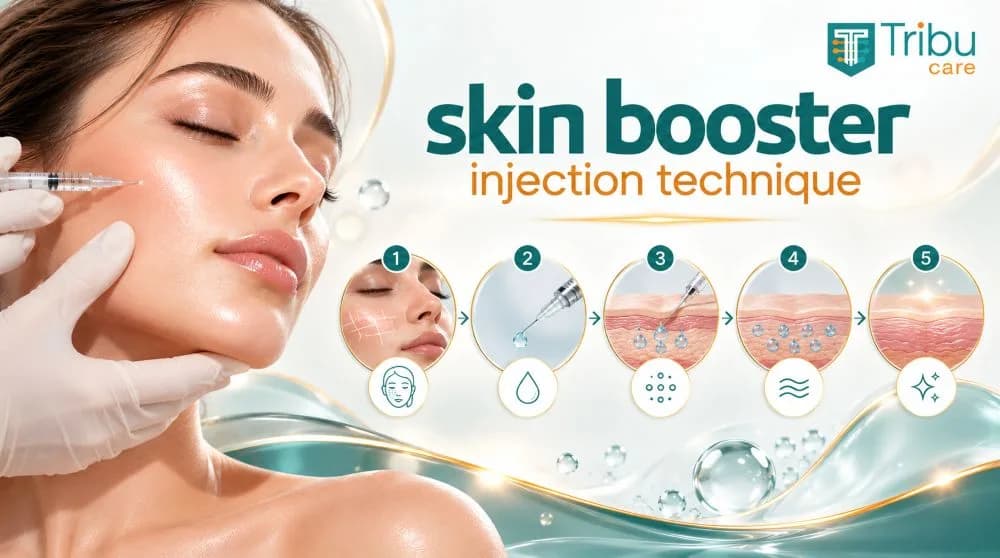
Simple diagram description: Picture a cross-section of skin. Small dermal depots sit in a grid under the epidermis. Water is drawn into each depot (hydration), the surrounding matrix is gently stretched, and fibroblasts around each depot receive a mechanical or biochemical signal.
What does the evidence show?
Evidence for skin booster injection is moderate for hydration and radiance, weaker for elasticity and pigmentation, and limited by heterogeneity in products and techniques.
The most useful recent summary is a systematic review and meta-analysis of local HA injection in skin ageing (Zhou et al., 2025, Journal of Cosmetic Dermatology). It screened 1,526 records, identified 12 randomised controlled trials with control groups and pooled six of them.
| Study | Design | n (pooled) | Key finding | Limitation |
|---|---|---|---|---|
| Zhou et al., 2025: hydration | Meta-analysis of RCTs (4 studies) | 404 | Significant improvement vs controls (SMD 1.34, 95% CI 0.14–2.54) | Very wide confidence interval; heterogeneous products and techniques |
| Zhou et al., 2025: radiance | Meta-analysis of RCTs (3 studies) | 307 | Significant improvement (SMD 0.51, 95% CI 0.22–0.80) | Variable patient characteristics |
| Zhou et al., 2025: elasticity | Meta-analysis of RCTs (3 studies) | 299 | No significant improvement (SMD 0.25, 95% CI −0.20 to 0.70) | Inconsistent results; elasticity depends on deeper collagen and elastin |
| Zhou et al., 2025: melanin index | Meta-analysis of RCTs (2 studies) | 68 | No significant reduction (SMD −1.74, 95% CI −4.89 to 1.41) | Small sample; interval includes benefit and harm |
The authors call for standardised protocols and long-term outcome data. For PN, a 2025 systematic review (Lampridou et al., Journal of Cosmetic Dermatology) is the main starting point; practitioners should read its included studies directly, as designs and outcome measures differ and are not summarised in this table. In short, the strongest signal is for hydration and radiance, and claims about structural remodelling should be framed cautiously.
Indications and patient selection
The best candidates for skin booster injection are patients with dehydrated, dull or fine-lined skin who want improved skin quality without a change in facial volume.
Likely good candidates
- Early to moderate skin ageing with dullness and loss of hydration
- Patients who want a natural-looking result and are comfortable with a series of sessions
- Dehydrated or fatigued-looking skin in areas such as the face, neck and décolletage
- Patients seeking skin quality maintenance alongside other aesthetic treatment
Suboptimal candidates
- Patients whose main concern is volume loss or deep static folds; a filler or structural approach is more appropriate
- Marked laxity, where evidence for elasticity improvement is weak
- Patients expecting a permanent or dramatic change
- Pigmentation as the primary concern, given the non-significant melanin finding above
Skin type, existing treatment history and realistic expectations should be documented before the first session.
Protocol and practical use
Protocols depend on the specific product, so dosing, depth, technique and session schedule should follow the manufacturer's instructions for use and the practitioner's training.
Because published trials differ in products and techniques, no single universal protocol can be recommended. Common elements in practice include:
- Technique: Popular injection techniques include micro-droplet (point-by-point) placement, linear threading and micropapules in the superficial to mid-dermis. Skin booster injection points are generally spaced across the cheeks, temples, forehead and neck according to the product's documented technique.
- Instrument: Fine needles or cannulas, as specified for the product.
- Sessions: Many products use an initial series of sessions spaced by several weeks, followed by maintenance. The exact number and interval are set by the manufacturer.
- Timing with other procedures: Space treatments with energy-based devices or peels according to product guidance and clinical judgement.
- Aftercare: Advise patients to avoid heat exposure, strenuous exercise and cosmetic procedures in the immediate period, and to use sun protection.
Skin boosters work as a year-round treatment plan rather than a seasonal one, but results are not permanent. Maintenance intervals vary by product and patient. Lips are sometimes treated with hydrating injections (a "lip booster" approach) to improve hydration and surface quality, which is distinct from volumising lip filler.
Combination approaches
Skin booster injection pairs well with measures that protect and support the skin barrier, and combinations should be sequenced rather than stacked in the same session without a plan.
Commonly paired
- Daily sun protection: essential to protect results.
- Barrier-supportive home care: moisturisers and hydrating serums. Review the evidence on niacinamide benefits for skin when advising patients on barrier and tone support.
- Staged in-clinic treatments: for example, a booster programme alongside separate filler or energy-based sessions, spaced per product guidance.
Use caution with
- Strong exfoliating acids and retinoids around treatment days; an irritant routine can compromise recovery. Patients with oily or acne-prone skin should have their routine reviewed (see the Arabic guide on a salicylic acid cleanser for oily skin).
- Multiple procedures on the same day without a documented plan.
- Active infection or inflammation in the treatment area.
Safety, contraindications and adverse events
Common adverse events after skin booster injection are mild and transient, but contraindications must be screened and rarer complications recognised early.
Common (typically short-lived): erythema, swelling, bruising, tenderness, and small palpable papules at injection points.
Less common: nodules or lumps, infection, delayed inflammatory reactions, and herpes simplex reactivation in susceptible patients. Vascular complications are rare with superficial, low-volume intradermal placement, but practitioners must still know the relevant anatomy and have a management plan.
Contraindications and precautions (confirm against each product's documentation):
- Pregnancy and breastfeeding: generally deferred because safety data are lacking
- Active skin infection, inflammation or herpes lesions in the area
- Known hypersensitivity to product components
- Autoimmune or bleeding disorders, anticoagulant use and a history of keloid or hypertrophic scarring: individual assessment
- Photosensitivity concerns and recent intense sun exposure
Management: Document consent and baseline photographs, use aseptic technique, and give patients a clear route to contact the clinic. Report adverse events through your local pharmacovigilance or device-vigilance system.
Comparison with alternatives
Skin boosters sit between topical care and structural treatments: they act on hydration and skin quality, whereas fillers act on volume and collagen stimulators on tissue remodelling.
| Category | Primary mechanism | Main target | Practical consideration |
|---|---|---|---|
| HA-based skin booster | Dermal water binding; proposed fibroblast signalling | Hydration, radiance, fine lines | Evidence strongest for hydration and radiance |
| PN-based injectable | Proposed fibroblast and repair signalling | Skin quality, texture | Evidence base developing; review primary studies |
| Cross-linked HA filler | Volume replacement | Folds, contour, structure | Not designed to improve overall skin quality alone |
| Collagen stimulator (e.g. PLLA, CaHA) | Stimulates neocollagenesis | Skin laxity, deeper support | Slower, remodelling-based onset |
| Microneedling or mesotherapy | Controlled injury or intradermal delivery | Texture, scars | Technique- and device-dependent |
| Topical HA and serums | Surface hydration | Daily maintenance | Limited depth of action |
Skin boosters in the TribuCare portfolio
TribuCare is the exclusive agent for global dermatology brands including Rejuran, a polynucleotide (PN)-based range, and supports partner clinics with documentation, training and after-sales service.
For clinics building a skin quality programme, the PN category in the portfolio is Rejuran. Indications, composition, technique and session schedules must be taken from the manufacturer's documentation, which TribuCare's medical team can provide. [Add Rejuran product page link and verified specifications before publishing.]
For between-session home care, the portfolio includes the Double Beauty Anti-Aging Facial Serum, a cosmetic product containing retinyl palmitate, hyaluronic acid, Colalift® 18, coenzyme Q10 and vitamin C. It is positioned to help improve the appearance of firmness, smooth the appearance of fine lines and hydrate the skin; it is intended for nightly use on clean skin and should be kept away from the eye area. As it contains a retinoid derivative, advise patients to review timing around procedures with their practitioner. [Add product page link.]
Partner clinics also receive medical training, hands-on product education and nationwide after-sales support.
FAQ for clinicians
What is the difference between a skin booster injection and a dermal filler? A skin booster injection aims to improve hydration and skin quality using small intradermal deposits, while a dermal filler uses more cross-linked material to restore volume or contour. They are complementary rather than interchangeable, and many patients benefit from a staged plan using both.
How many sessions are needed? This depends on the product. Manufacturer documentation specifies the initial series and maintenance interval, and published trials differ. Clinicians should follow the instructions for use for the specific product and adjust maintenance to the patient's response and goals.
How long do results last? Results are not permanent. Duration varies by product, patient age, skin condition and lifestyle, and published long-term data are limited. A maintenance-based plan, with sun protection, is generally more realistic than expecting a single course to last indefinitely.
Is skin booster injection suitable for all skin types? It is used across skin types, but patient selection matters. Active infection, inflammatory skin disease in the area, hypersensitivity to product components and pregnancy are reasons to defer. Pigmentation is a weak indication on current evidence.
What are the common side effects? Redness, swelling, bruising, tenderness and small papules at injection points are most common and usually settle within days. Nodules, delayed inflammatory reactions and infection are less common. Patients should know when and how to contact the clinic.
Can skin boosters improve skin elasticity? Current meta-analytic evidence did not show a significant elasticity improvement after local hyaluronic acid injection, although authors noted inconsistent results. Practitioners should avoid promising firmness gains and consider collagen-stimulating or energy-based options for laxity.
Can skin boosters be combined with other treatments? Yes, with planning. Sequence procedures according to product guidance, avoid stacking irritant treatments close together, and maintain daily sun protection. Document the plan so each procedure's timing and rationale are clear.
Skin booster injection products in the TribuCare portfolio
TribuCare distributes three skin booster injection products in Egypt, each aimed at a different clinical need: dermal matrix support, the periorbital area, and superficial dermal density. All details below are as stated on the manufacturer-based product pages.
Rejuran Healer is the main product in the Rejuran polynucleotide (PN) line. It contains PN at 20 mg/mL (2%) and is positioned for dermal matrix regeneration, thin or less elastic skin, fine lines and barrier recovery after laser or peeling. Stated treatment areas are the face, neck, upper chest and back of the hands, injected into the papillary dermis. The documented protocol is 3-4 sessions, 3-4 weeks apart, then maintenance every 6 months. It is supplied as prefilled syringes (2 x 2.0 mL per box) with 33G needles.
Rejuran I is a low-viscosity 2% PN formulation designed for the thin skin around the eyes: fine lines, thinning under-eye skin and the upper eyelids. The documented protocol is 3 sessions, 3-4 weeks apart, using a 34G needle. It is supplied as a 1.0 mL prefilled syringe.
Kiusera L is a different category: a liquid poly-L-lactic acid (PLLA) skin booster for mesotherapy, targeting the superficial reticular dermis. It is positioned for dermal density, enlarged pores, uneven texture and superficial fine lines, using multi-puncture, cannula or microneedling-assisted application over 3 sessions, 4 weeks apart. It is supplied as a 10 mL sterile vial.
Selecting between them: Rejuran Healer suits broader skin-quality programmes across the face and neck; Rejuran I suits a focused periorbital plan; Kiusera L suits practitioners who prefer a collagen-stimulating approach for superficial density. The pages do not list contraindications or precautions, so clinicians should confirm these in each product's instructions for use. TribuCare's medical team provides documentation, product education, hands-on training and nationwide after-sales support to partner clinics.
For between-session home care, the portfolio also includes the Double Beauty Anti-Aging Facial Serum, a cosmetic product containing retinyl palmitate, hyaluronic acid, Colalift(R) 18, coenzyme Q10 and vitamin C. It is positioned to help improve the appearance of firmness, smooth the appearance of fine lines and hydrate the skin, for nightly use on clean skin away from the eye area. As it contains a retinoid derivative, advise patients to review timing around procedures with their practitioner.
Conclusion
Skin booster injection offers a measured, evidence-informed way to improve hydration and radiance, with weaker support for elasticity and pigmentation. Its value depends on realistic expectations, careful patient selection, product-specific protocols and rigorous safety practice. Contact TribuCare's medical team for product documentation, training or partnership.
References
- Zhou et al. The Effect of Local Hyaluronic Acid Injection on Skin Aging: A Systematic Review and Meta-Analysis. J Cosmet Dermatol. 2025. doi:10.1111/jocd.16760. PMID 39807700. https://pubmed.ncbi.nlm.nih.gov/39807700/
- Lampridou et al. The Effectiveness of Polynucleotides in Esthetic Medicine: A Systematic Review. J Cosmet Dermatol. 2025. doi:10.1111/jocd.16721. https://onlinelibrary.wiley.com/doi/full/10.1111/jocd.16721
- Skin boosters: Definitions and varied classifications. Mahidol University repository. https://repository.li.mahidol.ac.th/handle/123456789/97700
- Manufacturer instructions for use for each product named (to be attached by TribuCare's medical team).
Related Reading
More insights from TribuCare
Beauty Innovation
Aminexil for Hair: Evidence, Use and Safety Review
Aminexil for hair explained for clinicians: mechanism, clinical evidence, patient selection, safety and how it differs from minoxidil. TribuCare.
October 19, 2026Mlay | Laser devices
MLAY in Egypt: Your Guide to At-Home IPL Hair Removal
Discover MLAY in Egypt and explore at-home IPL hair removal devices, available models, benefits, and why Tribu Care is the official MLAY distributor in Egypt.
September 9, 2026Mlay | Laser devices
MLAY in Egypt: Your Guide to At-Home IPL Hair Removal
Discover MLAY in Egypt and explore at-home IPL hair removal devices, available models, benefits, and why Tribu Care is the official MLAY distributor in Egypt.
September 9, 2026