
Silicone Gel for Scars: Evidence and Clinical Use
Silicone gel for scars explained for clinicians: mechanism, evidence from reviews, patient selection, protocol and safety. TribuCare medical team.
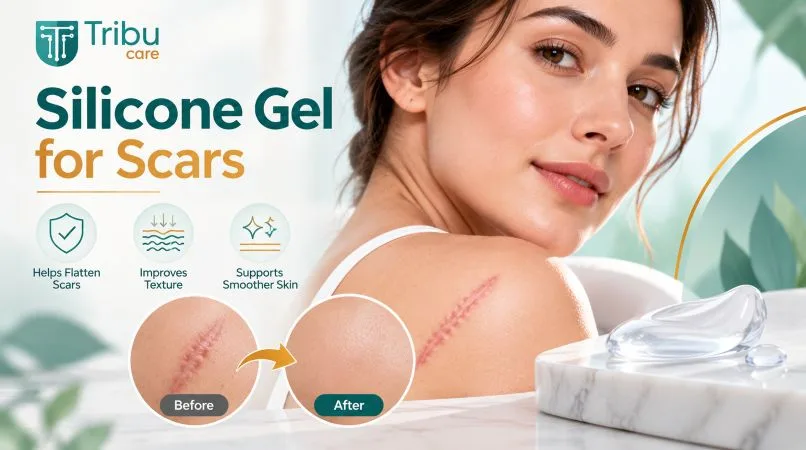
Scars are among the most common reasons patients return after surgery, trauma, burns and cosmetic procedures, and many ask what they can do at home. Silicone gel for scars is the topical option most often recommended as a first step, yet the published evidence is weaker than its reputation suggests.
For dermatologists, aesthetic physicians and pharmacists, the useful questions are how silicone is thought to work, what the reviews actually report, which scars and patients are suitable, and how to set realistic expectations alongside in-clinic options.
Key Takeaways
- Silicone gel for scars is a non-invasive, well-tolerated topical option positioned as first-line care, mainly for newly healed wounds and for scar prevention in prone patients.
- A Cochrane review of silicone gel sheeting reported weak, low-quality evidence of benefit; most trials were at high risk of bias.
- Silicone is proposed to work through hydration and occlusion of the stratum corneum, which may reduce collagen deposition; this is a hypothesis, not a proven pathway.
- In a network meta-analysis of treatments for hypertrophic scars and keloids, silicone ranked highest for tolerability but lowest for effectiveness and recurrence.
- Established hypertrophic scars, keloids and atrophic scars usually need physician-led treatment, with silicone used as supportive care.
What is silicone gel for scars and how is it classified?
Silicone gel for scars is a topical, leave-on formulation based on silicone polymers (such as polydimethylsiloxane) that forms a thin, breathable film over healed skin to help improve the appearance of scars.
It is related to silicone gel sheeting, which is the format most studied in trials. Gels are applied as a thin layer and dry to a flexible film, which makes them practical for the face, joints and other areas where sheets do not stay in place.
Silicone scar products are used for a range of scar types: newly healed surgical and cesarean section scars, scars after injury, burns and cosmetic procedures, and, as supportive care, hypertrophic scars and keloids. Regulatory classification depends on the product and market; some are registered as medical devices and others as cosmetics. Clinicians should check the registration and the manufacturer's documentation for each product before relying on any specific indication.
Mechanism of action
Silicone is thought to act by creating a hydrated, occluded environment over the scar, which may reduce the signals that drive excess collagen production.
The proposed mechanisms, as described in the literature, are:
- Hydration of the stratum corneum: Occlusion reduces transepidermal water loss, and the resulting hydration is thought to lower fibroblast collagen synthesis.
- Reduced inflammatory signalling: Hydration is hypothesised to downregulate TGF-beta2 and stabilise mast cells, limiting the inflammatory drive that promotes pathological scarring.
- Capillary effects: A hydrated, occluded environment is proposed to dampen capillary activity in the healing tissue.
- Barrier and protection: The film protects newly healed skin from friction and drying.
These mechanisms come from laboratory and clinical hypotheses, and earlier studies have reported conflicting findings. The effect on collagen remodelling in human scars is not established.
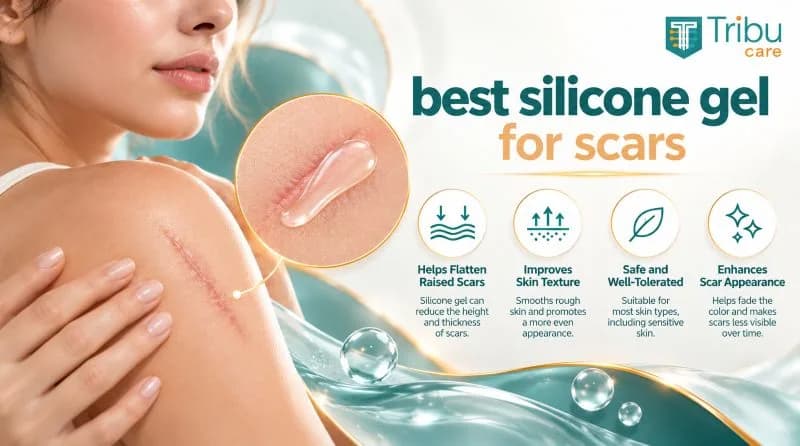
Simple diagram description: Picture a cross-section of a healed scar with a thin silicone film on the surface. Under the film, the stratum corneum is hydrated; below it, fibroblasts in the dermis receive fewer signals to over-produce collagen.
What does the evidence show?
Evidence for silicone is weak to moderate and mostly based on low-quality trials, with the best-supported use being scar prevention in people prone to hypertrophic scarring.
| Study | Design | n | Key finding | Limitation |
|---|---|---|---|---|
| O'Brien and Jones, 2013 (Cochrane) | Systematic review of RCTs of silicone gel sheeting | 20 trials; 873 participants | Prevention in scar-prone people: less hypertrophic scarring than no treatment (RR 0.46, 95% CI 0.21 to 0.98). Treatment: reduced scar thickness (MD -2.00, 95% CI -2.14 to -1.85) and improved colour (RR 3.49, 95% CI 1.97 to 6.15) | Low-quality evidence; studies highly susceptible to bias; sheeting rather than gel |
| Yang et al., 2021 (Frontiers in Medicine) | Network meta-analysis of RCTs of treatments for hypertrophic scars and keloids | 29 studies; 2,009 patients | Silicone ranked lowest for effective rate (SUCRA 18.3%) and recurrence (SUCRA 4.3%) but highest for tolerability (SUCRA 83.1%) | Short follow-up (12 weeks to 24 months); varied doses and intervals; a separate pooled effect for silicone alone not reported |
| International clinical recommendations (as summarised in a family medicine clinical review) | Guideline | n/a | Silicone gel sheeting listed as first-line therapy alongside intralesional corticosteroids | The same review graded the underlying evidence as weak |
Taken together, silicone has a good safety profile and a long-standing place in guidelines, but trial evidence does not show it matches active in-clinic treatments for established hypertrophic scars or keloids. Results from one product or format do not transfer automatically to another.
Indications and patient selection
The best candidates for silicone gel for scars are patients with newly healed, closed wounds, especially those at risk of hypertrophic scarring, and patients with mature, flat scars who want a low-risk supportive option.
Likely good candidates
- Newly healed surgical scars, including cesarean section scars
- Scars after injury, burns or cosmetic procedures, once the wound has re-epithelialised
- Patients with a personal or family tendency toward raised scarring, for prevention
- Facial or exposed scars where a gel is more practical than sheeting
Suboptimal candidates
- Open, infected or non-healed wounds
- Established keloids or thick hypertrophic scars that need intralesional or procedural treatment
- Atrophic scars, such as acne scars, where the concern is volume and dermal structure rather than raised tissue
- Patients expecting a scar to disappear; the aim is to improve appearance, not to erase it
Document scar type, age, location, symptoms (itch, pain, tightness) and baseline photographs before starting.
Protocol and practical use
Protocols follow the manufacturer's instructions; trials differ in duration and format, so consistency over months matters more than any single regimen.
Practical points for clinicians to share with patients:
- Start time: Begin only once the wound has fully closed and any sutures or dressings are no longer needed, unless the manufacturer states otherwise.
- Application: Apply a thin layer to clean, completely dry skin and allow it to dry before dressing or sunscreen.
- Frequency: Many gels are applied twice daily. For the portfolio product below, the documented regimen is twice daily with a two-minute one-direction massage, and no application on open wounds.
- Duration: Use is typically continued for months, with regular review. Published trials vary, so follow the product's documentation.
- Sun protection: Protect new scars from sun exposure to reduce the risk of pigmentary change.
- Follow-up: Photograph at regular intervals and escalate if the scar thickens, becomes symptomatic or does not improve.
Combination approaches
Silicone pairs well with measures that protect healing skin and with physician-led treatment for more significant scars, but each addition should have a clear purpose.
Commonly paired
- Sun protection and gentle skin care during scar maturation.
- Scar massage and pressure or taping where appropriate, per the clinician's advice.
- Physician-led treatments for thick or symptomatic scars, such as intralesional corticosteroids or procedural options chosen by the clinician.
- In-clinic skin-quality treatments for atrophic scars. See our skin booster injection guide, and the polynucleotide product SiiLK PDNA Platinum, whose manufacturer lists acne scars among its indications.
Use caution with
- Applying silicone over broken skin or a healing wound that has not yet closed
- Layering several leave-on products over the scar without guidance
- Starting multiple new treatments at once, which makes it hard to judge benefit or identify a reaction
Safety, contraindications and adverse events
Topical silicone is generally well tolerated; the main issues are local skin irritation, rash or maceration, and the product should not be applied to open wounds.
Common and mild: itching, redness or a rash in some patients, and occasional skin maceration under occlusive products in warm climates.
Less common: contact dermatitis to a formulation component. Stop use and review if irritation persists.
Precautions (confirm against each product's documentation):
- Do not apply to open or infected wounds
- Known hypersensitivity to any component
- Avoid contact with eyes and mucous membranes
- Pregnancy and breastfeeding: specific data are limited, so patients should consult their physician
- Any scar that changes rapidly, ulcerates or bleeds needs clinical assessment
In the network meta-analysis above, silicone showed the highest tolerability of the treatments compared, which supports its role as a low-risk option.
Comparison with alternatives
Silicone is the low-risk, supportive option; other categories offer stronger effect on established scars but need physician administration and carry more risks.
| Category | Primary mechanism | Best suited to | Practical consideration |
|---|---|---|---|
| Silicone gel or sheeting | Hydration and occlusion of the scar surface | New scars; prevention; mature flat scars | Best tolerated; evidence weak and low-quality |
| Intralesional corticosteroid | Anti-inflammatory; reduces fibroblast activity | Hypertrophic scars and keloids | Physician-administered; risk of atrophy and pigment change |
| Cryotherapy, laser and light-based treatments | Tissue remodelling or vascular and pigment targeting | Selected scar types and colour | Device- and operator-dependent |
| Polynucleotide or skin-quality injectables | Proposed fibroblast and repair signalling | Atrophic scars, skin quality | Physician-administered; evidence base developing |
| Surgical revision | Excision and re-closure | Wide, contracted or functionally limiting scars | Used selectively; needs post-operative scar care |
Salicylic acid gel products for acne-prone skin: where in-clinic care fits
A salicylic acid gel is a practical daily step for oily and acne-prone skin. As a keratolytic, it helps unclog pores and reduce the appearance of blemishes, which makes it a common first-line cosmetic option.
It does not address what acne can leave behind: textural change, post-acne scarring and uneven skin quality.
Once active acne is under control, many patients move from daily topical care to physician-led treatment aimed at skin repair, which is where the product below is relevant.
SiiLK PDNA Platinum: polynucleotide treatment for acne scars and skin quality
SiiLK PDNA Platinum, made by beaumed and represented in Egypt by TribuCare, is an injectable polynucleotide (PDNA) formulation for physician use.
It combines PDNA at 4 mg/mL with hyaluronic acid (5 mg/mL), glutathione (2 mg/mL), tranexamic acid (2 mg/mL) and peptides with growth factors. The manufacturer states indications that include acne scars, hydration, skin elasticity and regeneration, melasma and wrinkles, with treatment areas covering the face, neck and décolleté.
It is applied to the dermis by direct injection or with a meso injector or roller, one vial per session, every two weeks for three to five sessions. Visible results are reported from about three to four weeks after a procedure, with the fullest effect once the course is complete.
The product page does not state contraindications or precautions, so these should be confirmed in the manufacturer's documentation. Note that SiiLK PDNA Platinum does not contain salicylic acid; it complements a daily acne routine rather than replacing it.
Explore SiiLK PDNA Platinum and contact TribuCare's medical team for product documentation, training or partnership.
FAQ for clinicians
Does silicone gel for scars work? Evidence suggests a modest benefit, mainly for preventing hypertrophic scarring in people prone to it and for improving scar thickness and colour, but the underlying trials are low quality. It is a reasonable low-risk first step, not a substitute for treating established raised scars.
When should silicone gel be started? Once the wound has fully closed and any sutures or dressings are no longer needed, unless the product's documentation says otherwise. It should not be applied to open wounds. Early, consistent use is generally advised for patients at higher risk of hypertrophic scarring.
How long should patients use it? Manufacturer instructions govern, and published trials vary in duration. In practice, use is continued over months with regular review. Patients should expect gradual change in appearance, and escalate to the clinician if the scar thickens or becomes symptomatic.
Is silicone gel better than silicone sheets? Most trial evidence relates to sheeting. Gels are easier to use on the face, joints and large areas, while sheets provide pressure and occlusion. Evidence does not allow a firm head-to-head conclusion, so choose by site, comfort and adherence.
Can silicone treat keloids? Silicone is generally used as supportive care for keloids and hypertrophic scars rather than as the main treatment. In a network meta-analysis, silicone ranked lowest for effectiveness and recurrence among the options compared, so established keloids usually need physician-led therapy.
Are there side effects? Silicone is generally well tolerated. Itching, redness or rash can occur, and contact dermatitis is less common. Stop use and review if irritation persists, and never apply to open wounds.
Is silicone gel suitable for acne scars? Silicone is mainly studied for raised scars. Atrophic acne scars involve loss of tissue and usually need in-clinic approaches aimed at skin structure. Silicone may still support scar care and skin protection as an adjunct.
Conclusion
Silicone gel for scars is a safe, practical and widely recommended first step for newly healed and prone-to-scar wounds, supported by weak but consistent evidence of benefit and excellent tolerability. It should be framed honestly: it helps improve scar appearance, but it does not replace physician-led treatment for established hypertrophic scars, keloids or atrophic scars. Contact TribuCare's medical team for product documentation, training or partnership.
References
- O'Brien L, Jones DJ. Silicone gel sheeting for preventing and treating hypertrophic and keloid scars. Cochrane Database Syst Rev. 2013;(9):CD003826. https://www.cochrane.org/CD003826/SKIN_silicone-gel-sheeting-preventing-and-treating-hypertrophic-and-keloid-scars
- Yang S, Luo YJ, Luo C. Network meta-analysis of different clinical commonly used drugs for the treatment of hypertrophic scar and keloid. Front Med. 2021. https://www.frontiersin.org/journals/medicine/articles/10.3389/fmed.2021.691628/pdf
- What treatment is best for hypertrophic scars and keloids? Clinical Inquiries. J Fam Pract. https://mdedge.com/familymedicine/article/64559/dermatology/what-treatment-best-hypertrophic-scars-and-keloids
Related Reading
More insights from TribuCare
Beauty Innovation
PLLA Injection: Mechanism, Evidence and Clinical Protocol
PLLA injection explained for clinicians: mechanism, evidence, patient selection, protocol, safety and nodule management. TribuCare medical team.
October 19, 2026Beauty Innovation
Aminexil for Hair: Evidence, Use and Safety Review
Aminexil for hair explained for clinicians: mechanism, clinical evidence, patient selection, safety and how it differs from minoxidil. TribuCare.
October 19, 2026Skincare Science
Skin Booster Injection: Evidence & Clinical Protocol
Skin booster injection explained for clinicians: mechanism, evidence, patient selection, protocol and safety, plus TribuCare training support.
October 19, 2026