
PLLA Injection: Mechanism, Evidence and Clinical Protocol
PLLA injection explained for clinicians: mechanism, evidence, patient selection, protocol, safety and nodule management. TribuCare medical team.

Patients seeking facial and body rejuvenation increasingly ask for results that look natural and build gradually, rather than an immediate change in volume. PLLA injection is one of the biostimulatory options practitioners use for that goal: it uses injectable poly-L-lactic acid to stimulate the body's own collagen production, restoring structure over months.
The same gradual mechanism raises practical questions about patient selection, dilution, technique and managing nodules. This guide reviews how PLLA works, what the systematic evidence supports, and how to apply it safely in practice.
Key Takeaways
- PLLA injection uses a biodegradable synthetic polymer to stimulate collagen neogenesis; results appear progressively over months rather than at the time of injection.
- A systematic review of 11 randomised trials found PLLA effective and long-lasting for facial ageing and lipoatrophy, but rated the overall evidence as low quality.
- Most adverse events are mild and self-limiting; nodules are the main concern, and authors attribute them mainly to injection technique and dilution.
- Patient selection matters: PLLA suits gradual, structural improvement, not correction of deep folds that need immediate volume.
- International and regional consensus documents support its use on the face and body, and protocols should follow the manufacturer's documentation.
What is PLLA injection?
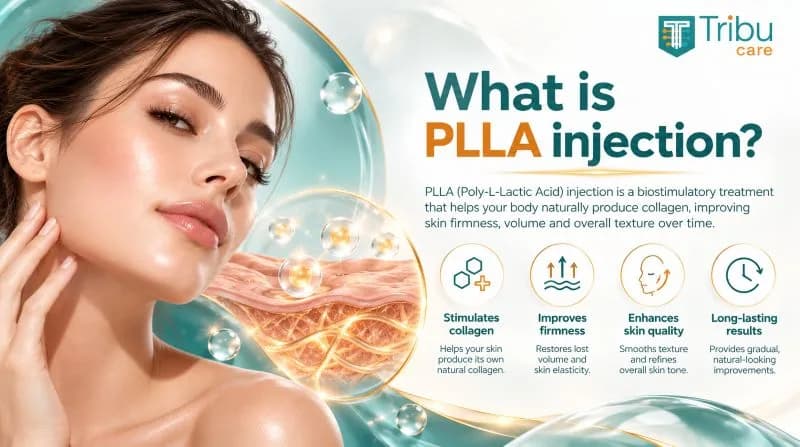
PLLA injection is an injectable treatment using poly-L-lactic acid, a biodegradable, biocompatible synthetic polymer, to stimulate dermal collagen production and gradually improve skin structure and volume.
PLLA belongs to the category of biostimulators (also called collagen stimulators), distinct from conventional dermal fillers. A filler such as cross-linked hyaluronic acid provides immediate volume by occupying space. A PLLA injectable provides little immediate volume; its effect comes from the tissue response that follows, so the result builds progressively. The literature describes PLLA used for facial ageing, lipoatrophy and, in expert consensus, at different body sites, where it is sometimes referred to as PLLA-SCA, a biostimulator term used in consensus papers.
PLLA is also used in other forms, such as threads, which are a separate product category and not injectables. Regulatory status depends on the product and market, and many PLLA products are registered as medical devices. Clinicians should verify the registration, intended use and instructions for the specific product.
Mechanism of action
PLLA is thought to act by provoking a controlled, mild inflammatory response around the particles, which recruits macrophages and fibroblasts and leads to new collagen deposition over weeks to months.
The commonly described sequence is:
- Injection into the dermis or subdermal plane: the product is placed as a suspension, and the carrier fluid is absorbed within a short time, so any immediate volume is transient.
- Cellular response: the particles trigger a mild inflammatory reaction in which macrophages and fibroblasts are recruited around them.
- Collagen neogenesis: fibroblasts deposit new collagen, with the stimulation of dermal collagen thickening the tissue over months.
- Degradation: PLLA is biodegradable; the polymer is gradually broken down by hydrolysis, and the structural benefit is attributed to the collagen laid down in its place.
This is why a notable inflammatory response is not the aim: the target is a mild, controlled reaction. Excessive or uneven deposition of product is associated with nodules, which is why dilution, placement and post-injection technique matter. Mechanistic reviews continue to refine the details, and some aspects of the cellular pathway remain under study.
Simple diagram description: Picture a cross-section of dermis with scattered PLLA particles. Around each particle, macrophages and fibroblasts gather; over time, collagen fibres accumulate between and around the particles, thickening the dermis as the particles degrade.
What does the evidence show?
Evidence suggests PLLA is effective and long-lasting for facial ageing and lipoatrophy, but the underlying trials are small, heterogeneous and mostly rated at risk of bias.
| Study | Design | n | Key finding | Limitation |
|---|---|---|---|---|
| Signori et al., 2024 (Polymers) | Systematic review (PROSPERO-registered, PRISMA) of RCTs in adults with facial ageing or lipoatrophy | 11 RCTs (from 1,467 citations screened) | Four studies reported increased dermal thickness and significant improvement in lipoatrophy severity and aesthetic scores, with effects lasting at least 25 months; PLLA favoured over some comparators in several trials | Five of 11 studies at high risk of bias, none low risk; evidence rated low quality; varied dilution protocols and outcome measures; no meta-analysis possible |
| Same review: safety | Adverse events across included trials | Not stated | Mostly mild to moderate (bruising, haematoma, tenderness, oedema, nodules), generally self-resolving; subcutaneous papules or nodules in 41% of participants in one trial | Authors attribute nodules mainly to injection and post-injection technique rather than the material |
| International consensus on injectable PLLA for body aesthetic treatments | Expert consensus | n/a | Provides evidence assessment and practical recommendations for body use | Consensus reflects expert opinion; protocols differ by product |
Most included studies used the same commercial product, which limits generalisability to other formulations. The authors conclude that PLLA appears effective and durable with a reasonable safety profile, while stressing that the evidence is low quality and needs further research. Practitioners should treat product-specific protocols as the reference.
Indications and patient selection
The best candidates for PLLA injection are patients seeking gradual improvement in skin quality, structure and volume who accept a multi-session course and a delayed result.
Likely good candidates
- Facial ageing with loss of structure and skin thickness, including mid and lower face
- Facial lipoatrophy
- Patients who prefer a natural-looking, progressive result and are comfortable with a series of sessions
- Selected body areas, as described in consensus recommendations, where skin laxity and texture are the concern
Suboptimal candidates
- Patients wanting immediate volume or correction of deep folds in one visit
- Thin or highly mobile areas where nodule risk is higher, unless the product and technique are designed for it
- Active infection, inflammation or skin disease at the treatment site
- Patients with a history of keloid or abnormal scarring, or unrealistic expectations
A clear consultation should cover goals, expected timeline (results develop over months), the number of sessions and the possible need for maintenance. For superficial skin-quality concerns, see our guide on skin booster injection, which compares hydration-focused and biostimulatory approaches.
Protocol and practical use
Protocols vary by product, so reconstitution, dilution, injection depth, volume and session interval must follow the manufacturer's instructions for use.
Because published trials used varied dilutions and techniques, no single universal protocol can be recommended. General practice points include:
- Preparation: Follow the manufacturer's reconstitution and hydration time. Poor mixing is associated with irregular distribution and nodules.
- Technique and depth: Placement is product-specific, such as deeper planes for volumising products or the superficial reticular dermis for fine, liquid formulations. Aspirate or use cannula techniques as the product directs.
- Comfort: Topical numbing agents, ice or anaesthetic injections with lidocaine may be used according to clinician preference and product guidance.
- Sessions: Courses usually comprise several sessions spaced by weeks, with a review before each. The number and interval are set by the manufacturer.
- Post-injection care: Massage and aftercare instructions, where the product calls for them, support even distribution.
- Review: Standardised photographs at baseline and follow-up help judge response, which develops over months.
Results are described as long-lasting but not permanent, and maintenance schedules depend on the patient and product.
Combination approaches
PLLA injection combines well with treatments that address different layers of ageing, but sequencing should follow product guidance and each addition needs a clear purpose.
Commonly paired
- Hyaluronic acid fillers for immediate volume or contour, placed in separate sessions or planes as the clinician judges.
- Skin-quality treatments such as skin boosters or polynucleotides, scheduled around PLLA sessions.
- Energy-based devices, with spacing as per product and device guidance.
- Home care: sun protection and barrier-supportive routines. See our guide on niacinamide benefits for a common daily active.
- Scar care: for healed injection sites or scars, see silicone gel for scars.
Use caution with
- Placing several products in the same plane in one session without a documented plan
- Stacking multiple procedures close together, which makes it hard to attribute a reaction
- Treating areas with active inflammation or infection
Safety, contraindications and adverse events
Most adverse events after PLLA injection are mild and self-limiting, while nodules are the principal concern and are mainly linked to technique, dilution and placement.
Common and mild: bruising, haematoma, tenderness, swelling and transient redness at injection sites, generally resolving on their own.
Less common: subcutaneous papules and nodules. In the systematic review above, such lesions were reported in 41% of participants in one trial, and the authors attribute them mainly to injection and post-injection technique rather than the material itself. Late nodules and inflammatory reactions can occur and need clinical review.
Precautions (confirm against each product's documentation):
- Active infection or inflammation at the site
- Known hypersensitivity to the product or its components
- Pregnancy and breastfeeding: data are lacking, so treatment is generally deferred
- History of keloids or abnormal scarring: individual assessment
- Autoimmune disease or immunosuppression: individual assessment
- Bleeding disorders or anticoagulant use: bruising risk
Management: Provide clear aftercare instructions, a contact route and follow-up. Assess nodules by type (palpable versus visible, early versus late, inflammatory or not) before choosing management, and document findings. Report serious events through your local device-vigilance system.
Comparison with alternatives
PLLA sits in the biostimulator category: slower than volumising fillers but aimed at the body's own collagen rather than a space-filling effect.
| Category | Primary mechanism | Onset | Best suited to | Practical consideration |
|---|---|---|---|---|
| PLLA biostimulator | Collagen neogenesis after a controlled tissue response | Gradual, over months | Structure, skin thickness, lipoatrophy, selected body areas | Dilution and technique critical; nodule risk |
| Cross-linked hyaluronic acid filler | Volume replacement | Immediate | Folds, contour, structure | Reversible; does not stimulate collagen as its main effect |
| Other collagen stimulators (e.g. calcium hydroxylapatite) | Particle-based neocollagenesis | Gradual | Laxity, deeper support | Product-specific technique |
| HA skin booster | Dermal hydration | Short-term | Skin quality, radiance | Evidence strongest for hydration |
| Polynucleotide injectable | Proposed fibroblast and repair signalling | Gradual | Skin quality, scars | Evidence base developing |
| Surgical lifting | Tissue repositioning | Immediate | Marked laxity | Invasive; separate indication |
Liquid PLLA in the TribuCare portfolio
TribuCare distributes a liquid PLLA product for physician use, and partner clinics receive documentation, medical training, product education and after-sales support. The details below are as stated on the product page.
Kiusera L, from beaumed, is described as a liquid poly-L-lactic acid (PLLA) skin booster ready for mesotherapy and fine injection. It is positioned to stimulate superficial collagen formation to improve the freshness and radiance of the skin and to increase dermal density without changing natural facial features or adding bulk. Stated indications are dermal re-densification and skin freshness, enlarged pores and uneven texture, and superficial fine lines. It targets the superficial reticular dermis and can be applied by multi-puncture mesotherapy, cannula or microneedling-assisted application. The documented programme is three sessions, four weeks apart. It is supplied as a 10 mL sterile glass vial, with CE (medical device directive) and ISO 13485 certification listed.
The product page does not state contraindications or precautions, so clinicians should confirm these in the manufacturer's documentation. For comparison with polynucleotide-based approaches to skin quality, see SiiLK PDNA Platinum. Partner clinics receive medical training, hands-on product education and nationwide after-sales support.
FAQ for clinicians
How does PLLA injection work? PLLA is a biodegradable polymer that triggers a mild, controlled tissue response. Macrophages and fibroblasts gather around the particles and deposit new collagen over weeks to months. The visible effect comes from that collagen, not from the injected volume, so results build gradually.
How long do PLLA results last? Trials in a systematic review reported effects lasting at least 25 months in some studies. Duration varies by product, area and patient, and results are long-lasting rather than permanent. Plan maintenance individually and follow the manufacturer's guidance.
How many sessions are needed? This depends on the product. Courses usually involve several sessions spaced by weeks, with review between them. For the liquid PLLA product in our portfolio, the documented programme is three sessions four weeks apart. Always follow the specific instructions for use.
What causes nodules after PLLA injection? Authors attribute nodules mainly to injection and post-injection technique, including dilution, placement depth and distribution, rather than to the material itself. Careful preparation, correct plane and aftercare reduce risk. Late or inflammatory nodules need clinical assessment before management.
Is PLLA a filler? PLLA is usually classed as a biostimulator or collagen stimulator rather than a conventional dermal filler. Fillers occupy space for immediate volume, while PLLA stimulates the body's own collagen, so the effect builds progressively over months. The categories are complementary.
Can PLLA be used on the body? International expert consensus provides evidence assessment and practical recommendations for PLLA at body sites. Protocols differ from facial use and by product, so clinicians should follow the manufacturer's documentation and consensus guidance for the specific area.
What anaesthesia is used for PLLA injection? Options include topical numbing agents, ice and, where appropriate, anaesthetic injections with lidocaine. The choice depends on the area, product and clinician preference.
Conclusion
PLLA injection is a biostimulatory option that builds structure and skin thickness gradually, with a reasonable safety profile in the evidence reviewed, but that evidence is low quality and technique-dependent. Careful patient selection, correct preparation and clear expectations about timing are what make it work. Contact TribuCare's medical team for product documentation, training or partnership.
References
- Signori R, de Paula Barbosa A, Cezar-dos-Santos F, et al. Efficacy and safety of poly-L-lactic acid in facial aesthetics: a systematic review. Polymers. 2024;16(18):2564. https://www.preprints.org/manuscript/202407.1452
- Injectable poly-L-lactic acid for body aesthetic treatments: an international consensus on evidence assessment and practical recommendations. https://www.ncbi.nlm.nih.gov/pmc/articles/PMC11965205/
- Unveiling the mechanism: injectable poly-L-lactic acid's evolving role: insights from recent studies. https://www.ncbi.nlm.nih.gov/pmc/articles/PMC11743305/
Related Reading
More insights from TribuCare
Beauty Innovation
Silicone Gel for Scars: Evidence and Clinical Use
Silicone gel for scars explained for clinicians: mechanism, evidence from reviews, patient selection, protocol and safety. TribuCare medical team.
October 19, 2026Beauty Innovation
Aminexil for Hair: Evidence, Use and Safety Review
Aminexil for hair explained for clinicians: mechanism, clinical evidence, patient selection, safety and how it differs from minoxidil. TribuCare.
October 19, 2026Skincare Science
Skin Booster Injection: Evidence & Clinical Protocol
Skin booster injection explained for clinicians: mechanism, evidence, patient selection, protocol and safety, plus TribuCare training support.
October 19, 2026