
Niacinamide Benefits: Evidence for Skin Care in Practice
Niacinamide benefits explained for clinicians: mechanism, evidence for pigmentation, barrier and sebum, safety and use in practice. TribuCare.

Niacinamide is one of the most talked-about skincare ingredients, and patients now arrive in clinic having already added it to their routine. The clinical question is not whether it is popular but what it can reasonably do. Niacinamide benefits are reported across oil regulation, barrier support, the appearance of skin tone and signs of ageing, and its oral form has a separate evidence base in skin cancer prevention.
This guide separates topical cosmetic use from oral use, summarises the trial data and its limits, and covers dosage, safety and how to advise patients.
Key Takeaways
- Niacinamide is the amide form of vitamin B3 (nicotinamide); it is not the same as niacin (nicotinic acid), which is a different form with different side effects.
- Topical niacinamide at cosmetic concentrations (commonly 2-5%) is generally well tolerated, and trials report improvements in the appearance of fine lines, spots and skin tone.
- Many trials are small, short and combine niacinamide with other actives, so its individual contribution is often hard to isolate.
- Oral nicotinamide has phase 3 evidence for reducing new nonmelanoma skin cancers in high-risk patients, but this is physician-supervised use, and the benefit was not seen after stopping.
- Cosmetic niacinamide products help improve appearance; they are not treatments for psoriasis, eczema or other skin diseases.
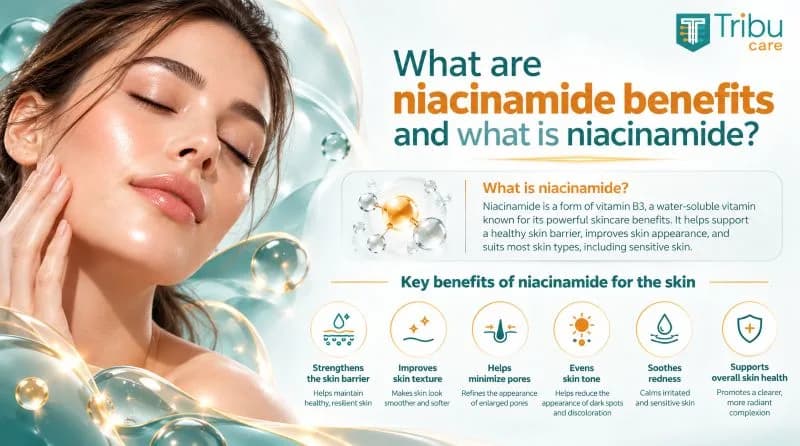
What are niacinamide benefits and what is niacinamide?
Niacinamide, also called nicotinamide, is the amide form of vitamin B3 and a precursor of NAD+ and NADP, coenzymes essential for cellular energy metabolism and repair.
Vitamin B3 exists in several forms. Niacin (nicotinic acid) is the acid form and can cause flushing, while niacinamide does not typically do so, which is one reason it dominates cosmetic use. It is water-soluble and is used in cleansers, serums, gels and moisturisers, alongside oral supplements.
The common uses fall into two groups:
- Topical cosmetic use: oil regulation, barrier support, hydration, and improving the appearance of pores, spots, texture and fine lines.
- Oral use: dietary supplementation, and, under medical supervision, skin cancer chemoprevention in selected high-risk patients.
Regulatory status depends on the product: topical niacinamide is a cosmetic ingredient in most markets, while oral nicotinamide is a supplement or, in some contexts, a medicine. Claims must follow the product's registration.
Mechanism of action
Niacinamide is thought to act mainly by supplying NAD+ for cellular repair and energy metabolism, supporting barrier lipid synthesis, and modulating inflammation and pigment transfer.
- Cellular energy and repair: As a precursor of NAD+, niacinamide supports energy metabolism and DNA repair, which underpins the interest in photo-damaged skin.
- Barrier function: It is reported to support the synthesis of barrier lipids such as ceramides and to improve hydration, helping reduce transepidermal water loss.
- Sebum and pores: Cosmetic data report reduced sebum excretion and a smoother look of pores in oily skin, though clinical sebum outcomes are not reported in every review.
- Pigmentation: Niacinamide is proposed to reduce the transfer of melanosomes from melanocytes to keratinocytes, rather than inhibiting melanin synthesis directly.
- Inflammation: It has anti-inflammatory activity that may help calm redness.
A published review notes that no single convincing molecular target has been identified, and that some mechanisms remain partly speculative. Findings in cell models are also inconsistent.
Simple diagram description: Picture an epidermal cross-section. Niacinamide enters keratinocytes and feeds the NAD+ pool; barrier lipids increase in the stratum corneum, and fewer pigment-containing melanosomes pass from melanocytes to surrounding keratinocytes.
What does the evidence show?
Evidence for topical niacinamide is moderate and mostly from small, short trials, while oral nicotinamide has a stronger, trial-based signal for skin cancer prevention in a specific high-risk group.
| Study | Design | n | Key finding | Limitation |
|---|---|---|---|---|
| Bissett et al., 2004 (as reviewed by Boo, 2021) | Split-face, 5% niacinamide moisturiser, twice daily, 12 weeks | 50 | Improvements over control in fine lines, pigmented spots, texture, redness and yellowing | Small; split-face; one concentration |
| Hakozaki et al., 2002 (as reviewed by Boo, 2021) | Split-face, 5% niacinamide, 8 weeks | 18 Japanese women | Significant decrease in hyperpigmented area at weeks 4 and 8 | Very small; single population |
| Navarrete-Solis et al., 2011 (as reviewed by Boo, 2021) | 4% niacinamide vs 4% hydroquinone in melasma, 8 weeks | 27 | Good-to-excellent improvement in 44% (niacinamide) vs 55% (hydroquinone); side effects in 18% vs 29% | Small; short; no placebo arm |
| Chen et al., 2015 (ONTRAC), N Engl J Med | Phase 3, double-blind RCT; oral nicotinamide 500 mg twice daily vs placebo, 12 months | 386 | New nonmelanoma skin cancer rate 23% lower (95% CI 4 to 38; P=0.02); fewer actinic keratoses | High-risk patients only; no evidence of benefit after stopping |
The review by Boo (2021) is a narrative review, not a systematic one, and notes that many trials combine niacinamide with other actives, are small or use split-face designs, and often recruit Japanese women, which limits generalisability. In one trial, 5% niacinamide reduced spots versus vehicle while 2% did not reach significance, and the effect faded after treatment stopped. Overall, the data support modest, concentration-dependent improvements in appearance, not dramatic or permanent change.
Indications and patient selection
The best candidates for topical niacinamide are patients with oily, dull, uneven or early-ageing skin who want a well-tolerated daily active that fits into an existing routine.
Likely good candidates
- Oily and combination skin with enlarged-looking pores and shine
- Dull or uneven skin tone and post-inflammatory marks, as an adjunct
- Early photo-ageing: fine lines, texture and spots
- Compromised-looking or dry skin that needs barrier support
- Patients who cannot tolerate stronger actives and want a gentler option
Suboptimal candidates
- Patients expecting a cosmetic product to treat psoriasis, eczema or other skin disease; the evidence in these conditions is limited and cosmetic products make no such claim
- Significant melasma or hyperpigmentation needing prescription-level treatment, where niacinamide is at best supportive
- Patients with known hypersensitivity to the product's other ingredients
- Anyone seeking skin cancer protection from a cream; the trial evidence concerns oral nicotinamide, and sun protection remains essential
Document skin type, concerns, current routine and any prescribed treatments before advising.
Protocol and practical use
Niacinamide works best as a consistent, long-term addition at a cosmetic concentration, introduced alone before layering other actives.
- Concentration: Trials most often used 2-5%. Higher concentrations are not clearly better, and tolerability depends on the whole formula.
- Frequency: Once or twice daily, as the product directs. Cleansers have a shorter contact time than leave-on gels and serums.
- Duration: Most trials ran 8-12 weeks, so visible change should be judged over weeks, with the effect depending on continued use.
- Order in the routine: Apply after cleansing and before moisturiser and sunscreen in the morning.
- Sun protection: Essential, particularly when targeting pigmentation.
- Introduction: Start with one product, watch for irritation for a week or two, then add others.
Oral nicotinamide: Dosing and duration should be set by the treating physician. The ONTRAC trial used 500 mg twice daily for 12 months in high-risk patients. Oral supplements are not a substitute for sun protection and skin checks.
Combination approaches
Niacinamide combines well with ingredients that support barrier and tone, and with sun protection, but several actives introduced together can obscure the source of irritation.
Commonly paired
- Sunscreen: the foundation of any pigmentation or ageing routine.
- Hydrating and barrier-supportive moisturisers with humectants and ceramides.
- Other brightening actives, such as tranexamic acid, kojic acid or arbutin, as used in some trial combinations; note that benefit in such studies cannot be attributed to niacinamide alone.
- Salicylic acid for oily, acne-prone skin; see our Arabic guide on a salicylic acid cleanser for oily skin.
- In-clinic care: after procedures, a gentle barrier-supporting routine is common. For injectable skin-quality approaches, see our skin booster injection guide, and for scar maturation, our guide on silicone gel for scars.
Use caution with
- Stacking several strong actives (acids, retinoids) at once on sensitive skin
- Starting multiple new products together
- Applying actives to broken or inflamed skin
Safety, contraindications and adverse events
Topical niacinamide at cosmetic concentrations is generally well tolerated, while high-dose oral supplements can cause gastrointestinal and other side effects and need medical oversight in some patients.
Topical, common and mild: transient redness, itching or a sensation of warmth in a minority of users, often related to the formulation rather than the niacinamide itself. A review reports no stinging or flushing at 10% in one application test and no irritation at 5% in single-use and 21-day cumulative irritation tests.
Oral, side effects: upset stomach, nausea, gas, headache and, at high doses, weakness or muscle pain. Niacin (nicotinic acid) is a different form that causes flushing; niacinamide generally does not. In the ONTRAC trial, no noteworthy difference in adverse events was reported between groups over 12 months.
Precautions (confirm against each product's documentation):
- Known hypersensitivity to any ingredient
- Patients with liver or kidney disease or diabetes should take oral supplements only under physician supervision; the review cited notes concern about long-term high oral doses affecting the liver, based on animal data
- Drug interactions: review current medicines before recommending oral supplements
- Pregnancy and breastfeeding: seek physician advice, especially for supplements
Stop use and review if a rash, swelling or persistent irritation develops.
Comparison with alternatives
Niacinamide is a gentle, multi-purpose active; stronger single-purpose actives may act faster but carry more irritation or supervision requirements.
| Category | Primary mechanism | Best suited to | Practical consideration |
|---|---|---|---|
| Topical niacinamide | NAD+ support; barrier lipids; reduced melanosome transfer | Oil control, tone, barrier, early ageing | Well tolerated; modest effect; often combined |
| Topical retinoids | Retinoid receptor signalling; cell turnover | Photo-ageing, acne | Stronger evidence for ageing; more irritation; pregnancy precautions |
| Hydroquinone | Tyrosinase inhibition | Melasma, hyperpigmentation | Prescription-level in many markets; supervised use |
| Vitamin C (topical) | Antioxidant; tyrosinase modulation | Photo-protection support, tone | Stability and irritation vary with formulation |
| Salicylic acid | Keratolytic | Oily, acne-prone skin | Can irritate; often paired with niacinamide |
| Oral nicotinamide | Systemic NAD+ support | Selected high-risk skin cancer patients | Physician-supervised; benefit not seen after stopping |
Niacinamide in the TribuCare portfolio
The Lustré range from Altesse Soin, the science-led dermo-cosmetic brand represented by TribuCare, combines niacinamide with vitamin C across three steps of a daily routine.
The right product depends on the goal: cleansing oily skin, helping reduce the appearance of dark spots and post-acne marks, or light hydration that keeps shine in check. All details below are as stated in the product information.
Lustré Foaming Cleanser with Vitamin C and Niacinamide combines niacinamide and vitamin C with salicylic acid, AHAs and licorice extract.
Niacinamide helps balance sebum, salicylic acid helps cleanse pores and AHAs provide gentle exfoliation. It is positioned for oily, combination and acne-prone skin. Apply 1-2 pumps to the wet face and neck, massage for 30-60 seconds, then rinse, morning and evening.
Lustré Serum with Vitamin C and Niacinamide combines niacinamide and vitamin C with the Sepiwhite™ brightening complex, alpha arbutin, licorice and pomegranate extracts and hyaluronic acid.
It is positioned to help reduce the appearance of dark spots and post-acne marks, improve radiance and smooth texture in oily and combination skin. The lightweight, fast-absorbing formula can be worn under makeup. Apply morning and evening after cleansing, to the face and neck, massaging gently until absorbed, with daily sunscreen to maintain results.
Lustré Gel Cream with Vitamin C and Niacinamide (50 mL) combines niacinamide and vitamin C with hyaluronic acid and panthenol. It is positioned to help hydrate, support the skin barrier, control shine, even out the look of skin tone and calm the look of redness, with alpha arbutin and licorice in the formula.
Apply a pea-sized amount to the face and neck morning and evening in upward circular motions, after the serum, and with SPF 50+ in the morning. It also works as a base before makeup.
The cleanser contains salicylic acid and AHAs, so daily sun protection and a gradual introduction on sensitive skin are advised. Indications, precautions and usage must be taken from each product's documentation.
Partner clinics receive medical training, hands-on product education and nationwide after-sales support.
FAQ for clinicians
What are the main niacinamide benefits for skin?
Trials report improvements in the appearance of fine lines, spots, texture, redness and skin tone, along with barrier and oil-control support. The data come mostly from small, short studies at 2-5%, so benefits should be presented as modest and gradual.
What concentration of niacinamide is effective?
Most trials used 2-5%. One study found 5% reduced spots versus vehicle while 2% did not reach significance. Higher is not clearly better, and tolerability depends on the whole formulation, so follow the product's documentation.
Is niacinamide the same as niacin?
No. Niacinamide is the amide form of vitamin B3 and does not typically cause flushing, while niacin (nicotinic acid) is the acid form and can. Both come from vitamin B3, but they are different compounds with different uses and side effects.
Can niacinamide treat acne, eczema or psoriasis?
Cosmetic niacinamide helps improve the appearance of oily, acne-prone skin and supports the barrier, but it is not a treatment for eczema or psoriasis. Evidence for those diseases is limited. Patients with inflammatory skin disease need physician-directed care.
Does niacinamide prevent skin cancer?
Oral nicotinamide reduced new nonmelanoma skin cancers by 23% in a phase 3 trial of high-risk patients, with no benefit after stopping. This does not apply to creams. It is physician-supervised use and does not replace sun protection or skin checks.
What are the side effects of niacinamide?
Topical use is generally well tolerated, with occasional redness or itching. Oral supplements can cause upset stomach, nausea, gas or headache. Patients with liver or kidney disease or diabetes should only take supplements under medical supervision.
Can niacinamide be used with other actives?
Yes, commonly with sunscreen, moisturisers and brightening actives. Introduce new products one at a time on sensitive skin. Where trials combine niacinamide with other agents, the benefit cannot be attributed to niacinamide alone.
Conclusion
Niacinamide benefits are real but modest for topical use: a well-tolerated active that supports barrier function, oil control and the appearance of tone and fine lines, with oral nicotinamide having a separate, physician-supervised role in skin cancer prevention. It works best as a consistent part of a routine alongside sun protection, with honest expectations. Contact TribuCare's medical team for product documentation, training or partnership.
References
- Boo YC. Mechanistic basis and clinical evidence for the applications of nicotinamide (niacinamide) to control skin aging and pigmentation. Antioxidants. 2021;10:1315. https://www.ncbi.nlm.nih.gov/pmc/articles/PMC8389214/
- Chen AC, et al. A phase 3 randomized trial of nicotinamide for skin-cancer chemoprevention. N Engl J Med. 2015. PMID 26488693. https://pubmed.ncbi.nlm.nih.gov/26488693/
- Manufacturer product information for each product named (to be attached by TribuCare's medical team).
Related Reading
More insights from TribuCare
Beauty Innovation
PLLA Injection: Mechanism, Evidence and Clinical Protocol
PLLA injection explained for clinicians: mechanism, evidence, patient selection, protocol, safety and nodule management. TribuCare medical team.
October 19, 2026Beauty Innovation
Silicone Gel for Scars: Evidence and Clinical Use
Silicone gel for scars explained for clinicians: mechanism, evidence from reviews, patient selection, protocol and safety. TribuCare medical team.
October 19, 2026Beauty Innovation
Aminexil for Hair: Evidence, Use and Safety Review
Aminexil for hair explained for clinicians: mechanism, clinical evidence, patient selection, safety and how it differs from minoxidil. TribuCare.
October 19, 2026