
Biotin for Hair: Evidence, Dosage and Clinical Considerations for Practitioners
Biotin for hair: what the evidence says on hair growth, deficiency, dosage, lab-test interference and when supplementation is justified.
Biotin for hair is one of the most frequent supplement questions in dermatology clinics and pharmacies, yet the evidence is narrower than its popularity suggests. This article summarises mechanism, deficiency, clinical evidence, dosing considerations and safety, including laboratory-test interference, to help practitioners advise patients accurately.
Biotin for Hair: What the Evidence Supports
Biotin for hair is supported by good evidence only where biotin deficiency is present; in healthy individuals, published reviews describe the evidence for improved hair growth as limited.
That distinction should frame any patient conversation. Biotin is an essential nutrient, and deficiency can cause hair thinning, so correcting a true deficiency is reasonable. Routine supplementation in patients with normal biotin status is a different question, and the data do not currently support confident claims.
| Clinical scenario | What the evidence supports |
|---|---|
| Confirmed or strongly suspected biotin deficiency | Supplementation is appropriate; hair and nail changes may improve once deficiency is corrected |
| Inherited disorders of biotin metabolism | Medical management under specialist care, usually at pharmacological doses |
| Healthy individuals with hair thinning or shedding | Limited evidence of benefit; other causes should be investigated first |
| Androgenetic alopecia, alopecia areata, telogen effluvium | No good evidence that biotin treats these conditions |
Two practical points follow from this table. First, hair loss should be worked up for its actual cause before a supplement is recommended. Second, biotin supplementation carries a specific safety consideration for laboratory testing, covered below.
Biotin Biochemistry: Why It Matters at the Cellular Level
Biotin, also called vitamin B7, is a water-soluble B vitamin that acts as a cofactor for carboxylase enzymes involved in fatty acid synthesis, gluconeogenesis and amino acid catabolism.
Five human carboxylases depend on biotin: acetyl-CoA carboxylase 1 and 2, pyruvate carboxylase, propionyl-CoA carboxylase and 3-methylcrotonyl-CoA carboxylase. Through acetyl-CoA carboxylase, biotin supports fatty acid synthesis, which matters for the lipid composition of skin and the sebaceous glands.
Keratin and follicle structure
Hair is composed predominantly of keratin, a structural protein. Biotin is frequently described as supporting keratin production and the structural integrity of hair follicles, largely through its role in protein synthesis and cellular metabolism in rapidly dividing cells. This mechanistic rationale is plausible, but it explains why deficiency is harmful rather than proving that supplementation above normal requirements increases hair growth.
Why the mechanism does not equal clinical efficacy
Adequate biotin is necessary at the cellular level. Once enzyme requirements are met, additional intake is not expected to accelerate follicular cycling. This is why the clinical picture differs sharply between deficient and non-deficient patients.
Biotin Deficiency: Causes, Features and Diagnosis
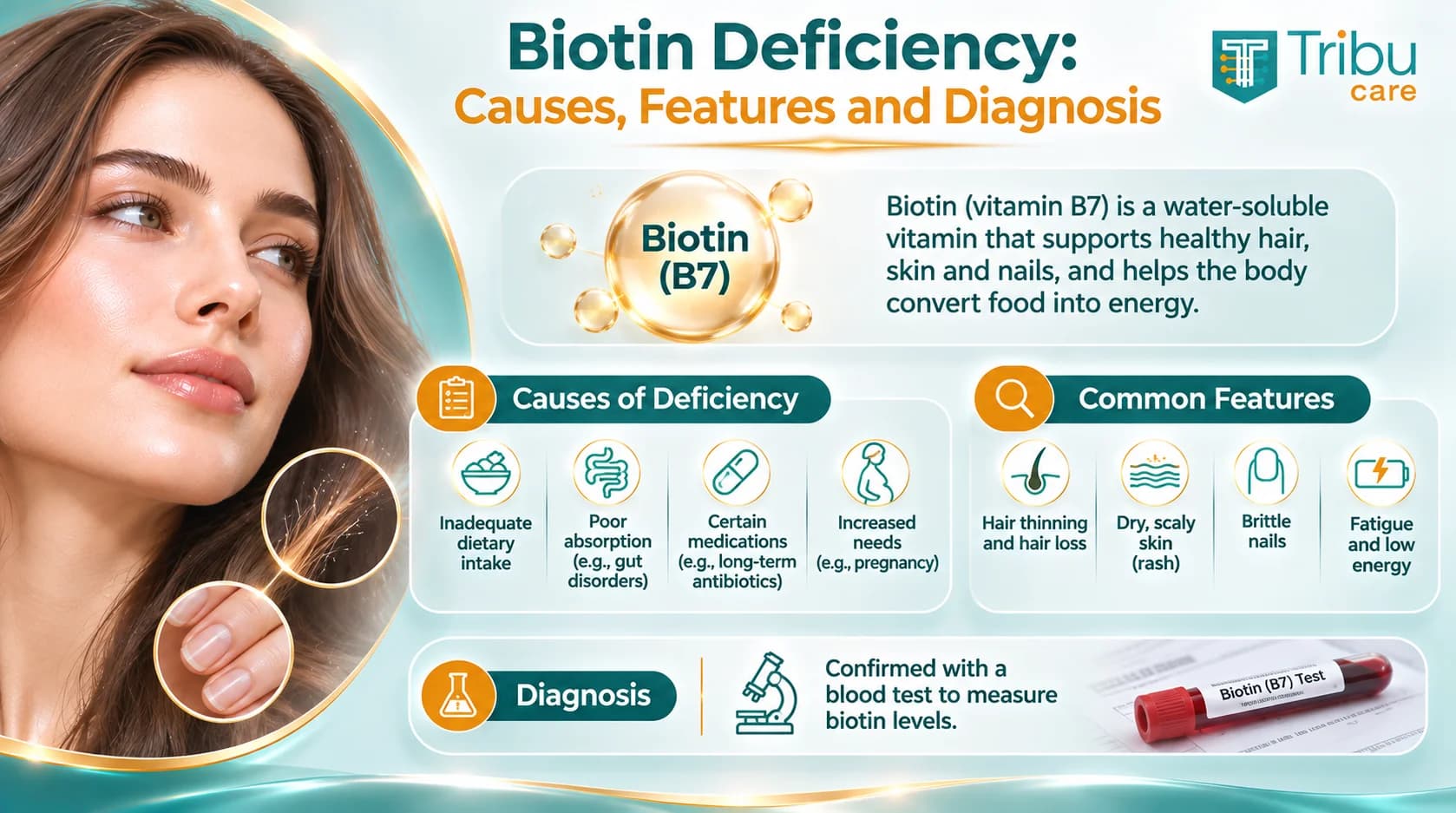
Biotin deficiency is rare in people eating a varied diet, but it is well described in inherited enzyme disorders and in specific acquired conditions, and it can present with hair thinning, rash and brittle nails.
Causes
| Category | Examples |
|---|---|
| Inherited | Biotinidase deficiency; holocarboxylase synthetase deficiency |
| Dietary | Prolonged, large intake of raw egg white (avidin binds biotin and limits absorption); long-term parenteral nutrition without biotin |
| Medication-related | Long-term anticonvulsant therapy (for example carbamazepine, phenytoin, primidone) has been associated with lower biotin status |
| Lifestyle and physiological | Chronic alcohol use; marginal biotin status has been reported in pregnancy |
| Gastrointestinal | Malabsorption and conditions affecting gut absorption |
Clinical features
Reported features include diffuse hair thinning or alopecia, a scaly erythematous rash, often around the orifices, brittle nails, conjunctivitis, and in more severe cases neurological symptoms such as lethargy, depression and paraesthesia. The dermatological findings are not specific, so deficiency should be considered alongside other nutritional and endocrine causes.
Diagnosis
Serum biotin is not routinely used in practice. Functional markers, such as increased urinary excretion of 3-hydroxyisovaleric acid, have been used to assess status, and diagnosis often rests on history, risk factors and response to supplementation. Practitioners suspecting an inherited disorder should refer to the appropriate metabolic specialist.
Biotin and Hair Growth in Healthy Individuals: Limited Evidence
In healthy individuals, there is limited scientific evidence that biotin supplementation increases hair growth or reduces hair loss, and available studies are small, heterogeneous or of low quality.
A review of biotin for hair loss concluded that benefit is documented in biotin deficiency and in a few rare conditions, while evidence in otherwise healthy people is insufficient (Patel et al., 2017). A separate analysis contrasted the clinical evidence with the popularity of biotin on social media and reached a similar conclusion (Soleymani et al., 2017).
Evidence summary by hair condition
| Condition | Quality of evidence for biotin | Practitioner note |
|---|---|---|
| Hair thinning due to biotin deficiency | Case reports and clinical observation | Correct the deficiency; investigate the cause |
| Uncombable hair syndrome | Case reports describing improvement | Specialist assessment; evidence remains limited |
| Brittle nails | Small studies; limited evidence | May be considered; counsel on realistic expectations |
| Telogen effluvium | No good evidence | Treat the trigger; check ferritin, thyroid function and history |
| Androgenetic alopecia | No good evidence | Use established treatments under medical supervision |
| Alopecia areata | No good evidence | Specialist management |
Why perceived benefit persists
Several factors can create an impression of efficacy: telogen effluvium frequently resolves spontaneously, patients often start supplements at the peak of shedding, and many commercial products combine biotin with other micronutrients, so attributing an effect to biotin alone is not possible.
Practitioners can therefore state accurately that biotin may help where deficiency exists, that it is a reasonable part of a balanced nutritional approach, and that it should not be presented as a proven treatment for hair loss.
Biotin Food Sources and Adequate Intake
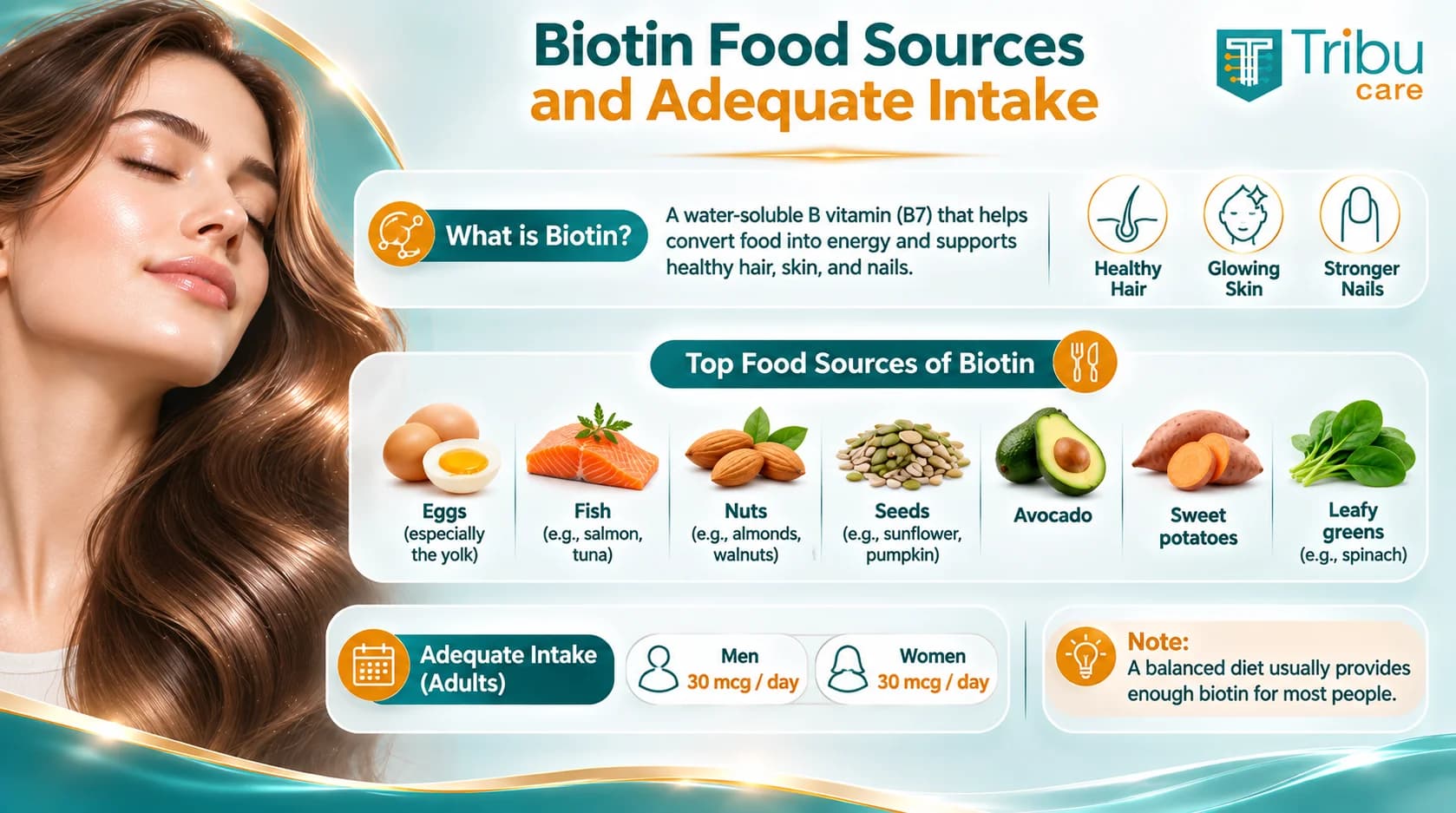
Most adults meet biotin requirements through diet; the US National Institutes of Health sets the adequate intake for adults at 30 mcg per day, with a slightly higher value of 35 mcg during lactation.
Because biotin is widely distributed in food and is also produced in part by gut microbiota, overt dietary deficiency is uncommon. Intake can be lower in people with restricted diets, malabsorption or heavy alcohol use.
| Food group | Examples of biotin-containing food sources |
|---|---|
| Animal sources | Liver, egg yolk (cooked), fish such as salmon, meat |
| Nuts and seeds | Almonds, sunflower seeds, peanuts |
| Vegetables | Sweet potato, spinach, broccoli |
| Legumes and grains | Soy, beans, whole grains |
| Other | Yeast products, bananas, dairy |
Practical notes on food
- Cooking egg white denatures avidin, so cooked egg does not carry the absorption concern associated with large amounts of raw egg white.
- Food processing and prolonged storage can reduce biotin content in some foods.
- A diet adequate in protein, iron, zinc and essential fatty acids is relevant to hair health independently of biotin, and these nutrients are more commonly implicated in diffuse shedding.
When advising patients, a brief dietary history is often more informative than empirical supplementation.
Biotin Supplements and Dosage: Formulations and Labelling
There is no established therapeutic dose of biotin for hair growth in healthy individuals, and commercial products vary widely, with many hair-focused supplements providing amounts well above the adequate intake.
Formulations
| Format | Considerations for practice |
|---|---|
| Tablets and capsules | Most common; strength is usually labelled in mcg (or mg for higher-strength products), so check units |
| Softgels | Similar content; may suit patients who prefer easier swallowing |
| Effervescent tablets | Review excipients, sodium content and sugar |
| Gummies | Check sugar content and the accuracy of labelled content |
| Combination formulas | Biotin with zinc, B-vitamins, vitamin C, vitamin E or other nutrients; effects cannot be attributed to biotin alone |
Dosage considerations
- Unit awareness: mcg and mg are frequently confused on labels; 1 mg equals 1,000 mcg.
- Higher is not better: water-soluble vitamins are largely excreted, but high intakes are the main driver of laboratory interference.
- Prescribed doses: Pharmacological doses used in inherited metabolic disorders are determined by specialists and should not be extrapolated to cosmetic use.
- Duration: Hair cycles are slow, so any assessment of response needs months, and a defined review point is advisable.
Practitioners should recommend a product with a transparent label, state the amount per serving, and use the manufacturer's directions unless a clinician specifies otherwise.
Biotin Safety, Adverse Effects and Laboratory-Test Interference
Biotin is generally well tolerated, but circulating biotin can interfere with immunoassays that use the biotin-streptavidin system, producing falsely high or falsely low results, which is the principal safety concern with supplementation.
The US Food and Drug Administration issued a safety communication in 2017 and updated it in 2019 on this issue. Assays most affected are those built on biotin-streptavidin binding. Depending on the assay design (sandwich or competitive), results can be erroneously low or high.
Tests reported as affected
| Test type | Reported direction of error |
|---|---|
| Cardiac troponin | Falsely low in some assays, with a risk of missed myocardial injury |
| Thyroid panel (TSH, free T4, free T3) | Patterns that can mimic hyperthyroidism, for example a falsely low TSH with falsely high thyroid hormones |
| Some hormone assays | Variable, assay-dependent |
| Some other immunoassay-based tests | Variable, assay-dependent |
Practical recommendations
- Ask every patient who presents with abnormal thyroid or cardiac results whether they take biotin.
- Advise patients to tell the laboratory and treating physician that they take biotin.
- Follow the interval recommended by the laboratory or assay manufacturer for withholding biotin before testing, as it varies by assay.
Other adverse effects
Adverse effects at typical supplemental doses are uncommon and mostly mild, including gastrointestinal discomfort. Hypersensitivity reactions are rare. Some case reports and observational data have linked high-dose biotin to acneiform eruptions, although a causal relationship is not firmly established.
A brief consultation note on biotin use can prevent misdiagnosis, especially in patients with thyroid or cardiac symptoms.
Precautions and Differential Diagnosis Before Recommending Biotin
Biotin supplementation is appropriate only after the cause of hair loss has been assessed, because most hair loss in patients with normal biotin status will not respond to additional biotin.
A structured assessment avoids treating the wrong problem and delays in diagnosing a treatable condition.
Conditions to consider before attributing hair loss to biotin deficiency
| Condition | Clinical clue | Typical work-up |
|---|---|---|
| Telogen effluvium | Diffuse shedding after a trigger such as illness, surgery, childbirth or restrictive dieting | History, pull test, trichoscopy |
| Androgenetic alopecia | Patterned thinning with miniaturisation | Clinical pattern, trichoscopy |
| Alopecia areata | Well-demarcated patches, exclamation-mark hairs | Clinical and trichoscopic examination |
| Iron deficiency | Diffuse shedding, fatigue | Ferritin, complete blood count |
| Thyroid dysfunction | Diffuse thinning, other systemic features | Thyroid function tests (see biotin interference above) |
| Other micronutrient deficiency | Dietary restriction, malabsorption | Targeted laboratory assessment, for example vitamin D or zinc |
Pregnancy and lactation
Biotin requirements are higher during lactation, and the adequate intake is set accordingly. Use in pregnancy and lactation should follow the treating physician's judgement and the labelled intake. High-dose supplementation is not supported by robust data in these groups.
Medications and medical conditions
- Long-term anticonvulsant therapy has been associated with lower biotin status in some reports; clinicians should review the full medication list.
- Patients with malabsorption, prolonged parenteral nutrition or a history of bariatric surgery may be at higher risk of deficiency and merit nutritional review.
- Patients with suspected thyroid or cardiac disease need coordinated communication with the laboratory regarding biotin use.
Persistent or progressive hair loss warrants clinical evaluation rather than empirical supplementation alone.
Practical Protocol Considerations for Clinic and Pharmacy Practice
A practical approach is to confirm the diagnosis, check nutritional and laboratory status, supplement only when indicated, and reassess clinically after a defined period rather than continuing indefinitely.
| Step | Consideration |
|---|---|
| 1. History | Diet, medications, recent triggers, existing biotin or multivitamin use |
| 2. Examination | Pull test, trichoscopy, pattern of loss |
| 3. Investigations | Ferritin, thyroid function, other tests guided by history; record biotin use on the request form |
| 4. Decision | Biotin where deficiency is documented or risk factors are present; other causes managed on their own merits |
| 5. Counselling | Labelled intake only, unit awareness (mcg), disclosure of biotin use before blood tests |
| 6. Follow-up | Clinical reassessment; hair cycles are slow, so changes are judged over months rather than weeks |
Counselling points for patients
- Dietary supplements do not replace a balanced diet.
- Results vary between individuals, and biotin does not suit every cause of hair loss.
- Report any new rash, gastrointestinal symptoms or hypersensitivity.
- Inform the laboratory and the treating physician about biotin before any blood test.
Topical and cosmetic adjuncts
Where a cosmetic approach is wanted alongside nutritional review, products that help reduce hair fall or improve the appearance of hair density can be considered as supportive care. They do not treat the underlying diagnosis, and persistent loss needs medical assessment.
Frequently Asked Questions on Biotin for Hair
Does biotin promote hair growth in healthy individuals?
Evidence is limited for healthy individuals with normal biotin status. Published reviews report benefit mainly where deficiency or a related disorder is present. Hair cycles are slow, so any change is judged over months.
Can biotin deficiency cause hair loss?
Yes, in confirmed deficiency, hair thinning is a recognised feature, often alongside skin and nail changes. Deficiency is uncommon and usually linked to specific causes such as genetic disorders, malabsorption or prolonged raw egg-white intake.
What are the main dietary biotin sources?
Biotin occurs in foods such as eggs, organ meats, fish, nuts, seeds and some vegetables. A varied diet usually meets the adequate intake, so supplementation is not routinely needed.
Does biotin affect laboratory results?
Yes. Biotin can interfere with some immunoassays, including troponin and thyroid tests, giving falsely high or low results. Patients should inform the laboratory and follow its guidance on stopping biotin before testing.
Who should avoid or seek advice before using biotin?
Pregnant or breastfeeding patients, those on long-term anticonvulsants, and anyone due for thyroid or cardiac testing should consult their physician first. Persistent hair loss needs clinical assessment.
Conclusion: Where Biotin for Hair Fits in Clinical Practice
Biotin for hair is best positioned as a targeted nutritional measure for documented deficiency or risk factors, not as a routine treatment for hair loss in patients with normal biotin status.
The evidence supports a clear biochemical role for biotin as a cofactor in keratin-related metabolism, yet clinical data in healthy individuals remain limited. Accurate diagnosis, a review of diet and medications, and awareness of laboratory-test interference matter more than the choice of supplement. Practitioners who do recommend supplementation should counsel on labelled intake, disclosure before blood tests, and reassessment after a defined period.
TribuCare's portfolio can complement this approach within a clinician-led assessment. Persistent or progressive hair loss should always be evaluated medically.
References
- National Institutes of Health, Office of Dietary Supplements. Biotin: Fact Sheet for Health Professionals.
- Patel DP, Swink SM, Castelo-Soccio L. A review of the use of biotin for hair loss. Skin Appendage Disorders. 2017.
- Soleymani T, Lo Sicco K, Shapiro J. The infatuation with biotin supplementation: is there truth behind its rising popularity? A comparative analysis of clinical efficacy versus social popularity. Journal of Drugs in Dermatology. 2017.
- US Food and Drug Administration. The FDA warns that biotin may interfere with lab tests: FDA Safety Communication. 2017; updated 2019.
Related Reading
More insights from TribuCare
Clinical Practice
Kojic Acid Cream Benefits: Evidence, Safety and Clinical Use for Practitioners
Kojic acid cream benefits explained: tyrosinase inhibition, evidence in melasma and post-inflammatory pigmentation, combinations and safety precautions.
November 30, 2026Beauty Innovation
Liposomal Glutathione Benefits: Evidence, Bioavailability and Safe Use for Practitioners
Liposomal glutathione benefits explained: antioxidant role, absorption, evidence for skin, liver and immune support, safety precautions and practical use.
November 1, 2026Beauty Innovation
Retinyl Palmitate for Skin: Evidence, Mechanism and Safe Use for Practitioners
Retinyl palmitate for skin explained: a fat-soluble vitamin A ester, how it compares with retinol, evidence, formulation, combinations and safety precautions.
November 1, 2026