
Retinyl Palmitate for Skin: Evidence, Mechanism and Safe Use for Practitioners
Retinyl palmitate for skin explained: a fat-soluble vitamin A ester, how it compares with retinol, evidence, formulation, combinations and safety precautions.
Retinyl palmitate for skin is a fat-soluble vitamin A ester, formed from retinol and palmitic acid, used in cosmetic lotions and serums to help improve the appearance of fine lines and uneven texture. This guide covers its chemistry, evidence, comparison with retinol, formulation and safety for dermatologists, aesthetic physicians and pharmacists.
Retinyl Palmitate for Skin: What the Evidence Supports
Retinyl palmitate for skin is a gentle, stable vitamin A ester with a plausible mechanism for helping improve the appearance of fine lines and texture, but direct clinical evidence for the ester itself is limited.
Retinyl palmitate (INCI: Retinyl Palmitate) must be converted in the skin to retinol, then retinaldehyde, then retinoic acid, before it acts on retinoic acid receptors. Each step reduces the amount of active compound, so the ester is generally regarded as the mildest of the cosmetic retinoids. Most of the clinical literature on topical vitamin A in photoaged skin concerns retinol and prescription retinoids (Mukherjee et al., 2006; Kafi et al., 2007).
| Claimed benefit | Level of support | Comment |
|---|---|---|
| Helps improve the appearance of fine lines | Limited for the ester itself | Evidence is stronger for retinol and retinoic acid |
| Improves the appearance of skin texture and tone | Limited | Plausible through the retinoid pathway; data on the ester are sparse |
| Antioxidant and skin-conditioning role | Laboratory data | Vitamin A esters are used in cosmetic conditioning |
| Tolerability in sensitive skin | Plausible, limited data | Lower irritation potential is expected from slow conversion |
Practitioners should therefore position retinyl palmitate as a mild, well-tolerated entry-level vitamin A, not as a substitute for prescription retinoids in established photoaging or acne.
Chemistry: A Fat-Soluble Ester of Retinol and Palmitic Acid
Retinyl palmitate is the ester formed by combining retinol with palmitic acid, a saturated fatty acid, which makes the molecule fat-soluble and more stable than free retinol.
The esterification protects the hydroxyl group of retinol from oxidation. The result is a lipophilic compound that dissolves in the oily phase of lotions and serums and is stored in skin as a vitamin A reservoir. In the epidermis, esterases release retinol, which is then oxidised to retinaldehyde and retinoic acid.
| Feature | Retinyl palmitate |
|---|---|
| INCI name | Retinyl Palmitate |
| Structure | Ester of retinol and palmitic acid |
| Solubility | Fat-soluble (lipophilic) |
| Stability | Higher than retinol; still sensitive to light and air |
| Activation | Hydrolysis to retinol, oxidation to retinaldehyde, then retinoic acid |
| Relative potency | Lower than retinol and retinoic acid |
The multi-step conversion explains both the lower irritation and the lower potency. Any given concentration of the ester delivers less retinoid activity than the same amount of retinol.
Retinyl Palmitate Versus Retinol and Other Retinoids
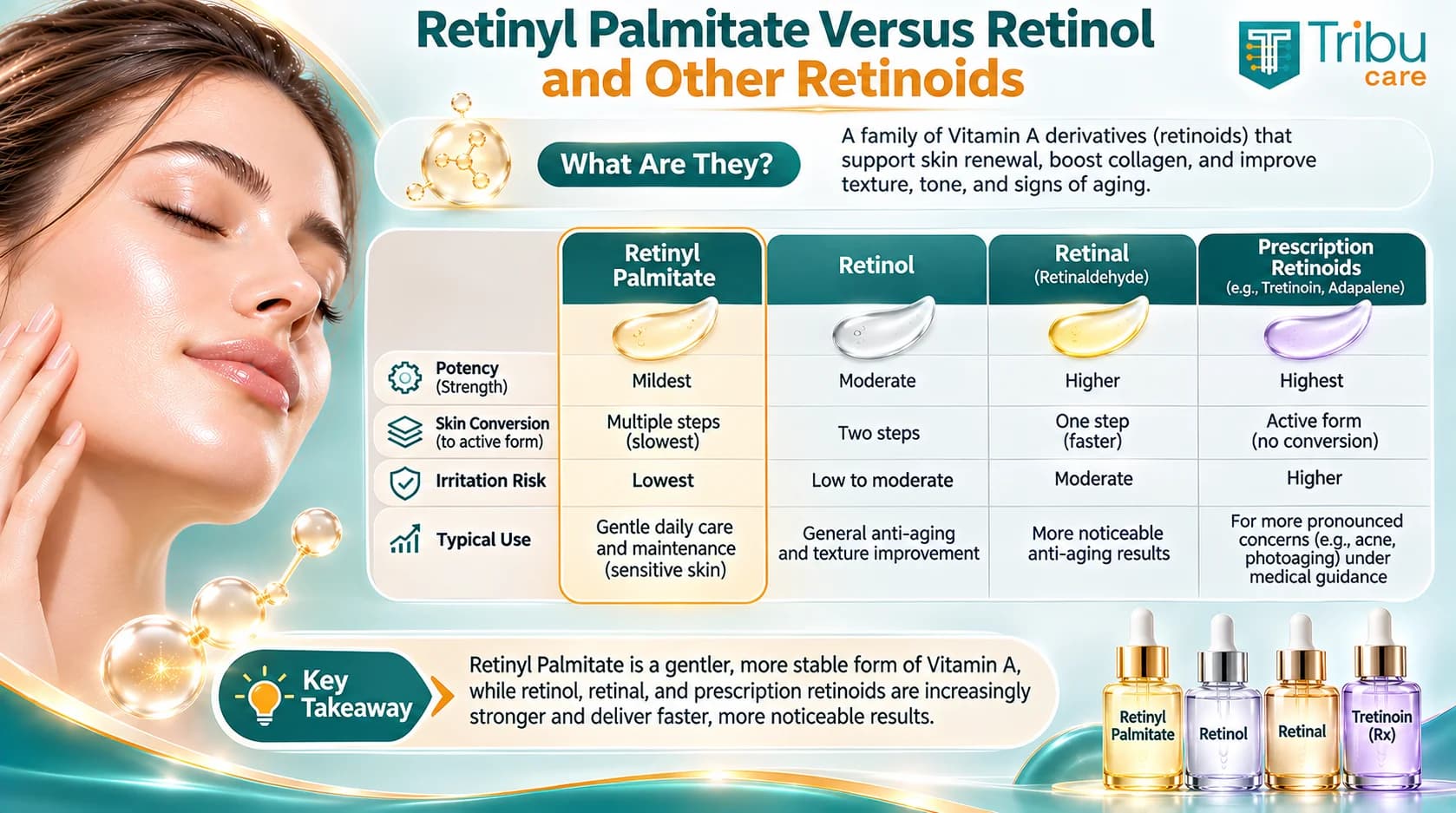
Retinyl palmitate is milder and more stable than retinol, which in turn is milder than retinoic acid, so the ester suits sensitive skin and first-time users while stronger retinoids suit established photoaging.
A comparative study of retinol and retinoic acid reported that retinol produced changes in the same direction as retinoic acid but with less irritation (Kong et al., 2016). The ester sits earlier in the same pathway and is expected to be milder still.
| Retinoid | Position in pathway | Potency | Irritation potential | Status |
|---|---|---|---|---|
| Retinyl palmitate | Furthest from retinoic acid | Lowest | Lowest | Cosmetic |
| Retinol | One step closer | Moderate | Moderate | Cosmetic |
| Retinaldehyde | Direct precursor | Higher | Moderate to higher | Cosmetic or regulated by region |
| Retinoic acid (tretinoin) | Active form | Highest | Highest | Prescription medicine |
The choice depends on the clinical goal and tolerance. Patients who do not tolerate retinol may start with a retinyl palmitate product, while patients with acne or marked photoaging typically need medical assessment and may require prescription retinoids.
Formulation: Retinyl Palmitate in Lotions and Serums, and Combining With Other Actives
Retinyl palmitate is formulated in lotions, serums and creams, usually for night use, and combines well with hydrating and antioxidant ingredients but needs staged introduction alongside exfoliating actives.
Because it is fat-soluble, it sits well in emulsions and oil-based serums. Opaque, airtight packaging protects the vitamin A ester from light and oxidation, and the label's storage instructions should be followed.
| Partner | Rationale | Precaution |
|---|---|---|
| Hyaluronic acid | Hydration, offsets dryness | Well tolerated |
| Vitamin C | Antioxidant, complements photoaging care | Layering may irritate; separate morning and night use |
| Coenzyme Q10 | Antioxidant | Well tolerated |
| Niacinamide | Supports barrier | Well tolerated |
| Alpha- and beta-hydroxy acids | Overlapping exfoliation | Avoid stacking on the same night unless supervised |
| Benzoyl peroxide | Can degrade some retinoids | Apply at different times |
| Broad-spectrum sunscreen | Protects retinoid-treated skin | Essential in the morning |
Combining several actives at once complicates attribution of any reaction, so each new product should be introduced separately.
Retinyl Palmitate Safety: Irritation, Photosensitivity and Pregnancy
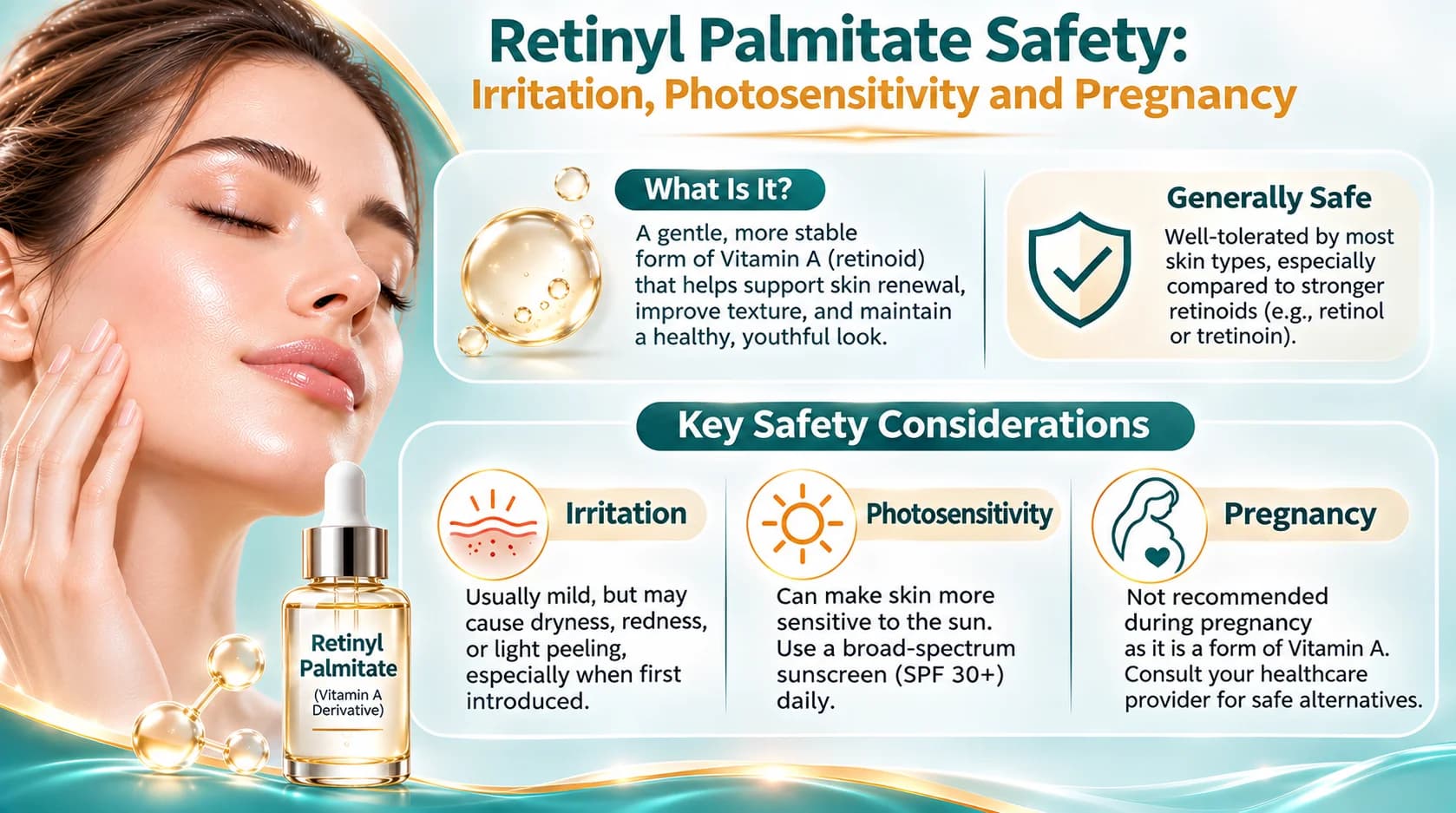
Retinyl palmitate is generally well tolerated in cosmetic use, but dryness, redness and sun sensitivity can occur, and pregnancy and lactation call for physician guidance because high systemic vitamin A intake is teratogenic.
| Concern | Note |
|---|---|
| Dryness, redness, peeling | Possible, especially when starting or combining with exfoliants |
| Photosensitivity | Retinoid-treated skin is more sun-sensitive; apply at night and use sunscreen daily |
| Contact dermatitis | Uncommon; patch test before first use |
| Photocarcinogenicity (animal data) | A US National Toxicology Program study in hairless mice reported a higher rate of skin tumours when retinyl palmitate creams were applied before UV exposure; relevance to human use is uncertain, and it reinforces strict sun protection |
| Pregnancy and lactation | Systemic vitamin A excess is teratogenic; topical retinoids are generally avoided in pregnancy unless the physician advises otherwise |
Special groups
- Pregnancy, lactation and women planning pregnancy: consult the treating physician before use.
- Sensitive skin, eczema, rosacea: start with low frequency or avoid until the barrier recovers.
- Broken or sunburned skin: do not apply.
- Eye area: avoid unless the label allows.
Stop use and seek advice if severe irritation, swelling or blistering occurs.
Practical Protocol and Counselling for Clinic and Pharmacy
A practical protocol introduces the product at night, at low frequency, on clean dry skin, with a moisturiser and daily broad-spectrum sunscreen, and reviews response after several weeks.
| Step | Consideration |
|---|---|
| 1. Assess | Skin type, goals, current actives, pregnancy status |
| 2. Patch test | Small area before regular facial use |
| 3. Start slowly | Follow the label; begin at a low frequency and increase as tolerated |
| 4. Support the barrier | Fragrance-free moisturiser; gentle cleanser |
| 5. Protect | Sunscreen every morning |
| 6. Review | Reassess after several weeks; refer if irritation persists or if stronger treatment is needed |
Counselling points
- Results are gradual and vary between individuals.
- Mild dryness can occur early on; reduce frequency rather than stopping at once.
- Avoid the eye area and broken skin.
- Dietary supplements and vitamin A in other products add to total intake; avoid duplicating retinoids without medical advice.
- Persistent acne, melasma or marked photoaging should be assessed by a dermatologist.
Notes for prescribers and pharmacists
- It is a cosmetic product that helps improve the appearance of fine lines and dullness. It does not treat photoaging or replace prescription retinoids.
- Patch test first; apply sunscreen every morning.
- Avoid the eye area, broken skin and combination with other retinoids unless advised.
- Pregnant or breastfeeding patients should consult their physician first.
Frequently Asked Questions on Retinyl Palmitate for Skin
What is retinyl palmitate?
Retinyl palmitate is a fat-soluble ester of retinol and palmitic acid. It is a stable, mild cosmetic form of vitamin A used in lotions and serums.
Is retinyl palmitate as effective as retinol?
It is milder and less potent, because the skin must convert it to retinol and then to retinoic acid. Clinical evidence is stronger for retinol and prescription retinoids.
Can it be used in pregnancy?
Pregnant and breastfeeding patients should consult their physician before use, since systemic vitamin A excess is teratogenic and topical retinoids are generally avoided.
Should it be used in the morning?
Night use is usual, with sunscreen every morning, because retinoid-treated skin is more sun-sensitive.
Can it be combined with vitamin C?
Yes, in formulations designed for it, but layering separate products may irritate. Introduce actives one at a time.
Conclusion: Retinyl Palmitate for Skin in Practice
Retinyl palmitate for skin is best positioned as a mild, stable vitamin A ester for sensitive or first-time users, helping improve the appearance of fine lines and texture, not as a replacement for prescription retinoids.
Its conversion to retinoic acid is slow and limited, which explains both its tolerability and its modest potency. Skin assessment, patch testing, night use, staged introduction of actives and daily sunscreen matter more than the choice of any single retinoid. Persistent or significant skin concerns should be assessed by a dermatologist.
References
- Mukherjee S, Date A, Patravale V, et al. Retinoids in the treatment of skin aging: an overview of clinical efficacy and safety. Clinical Interventions in Aging. 2006.
- Kafi R, Kwak HS, Schumacher WE, et al. Improvement of naturally aged skin with vitamin A (retinol). Archives of Dermatology. 2007.
- Kong R, Cui Y, Fisher GJ, et al. A comparative study of the effects of retinol and retinoic acid on histological, molecular, and clinical properties of human skin. Journal of Cosmetic Dermatology. 2016.
- US National Toxicology Program. Photocarcinogenesis study of retinoic acid and retinyl palmitate in SKH-1 mice. 2012.
Related Reading
More insights from TribuCare
Clinical Practice
Kojic Acid Cream Benefits: Evidence, Safety and Clinical Use for Practitioners
Kojic acid cream benefits explained: tyrosinase inhibition, evidence in melasma and post-inflammatory pigmentation, combinations and safety precautions.
November 30, 2026Clinical Practice
Biotin for Hair: Evidence, Dosage and Clinical Considerations for Practitioners
Biotin for hair: what the evidence says on hair growth, deficiency, dosage, lab-test interference and when supplementation is justified.
November 1, 2026Beauty Innovation
Liposomal Glutathione Benefits: Evidence, Bioavailability and Safe Use for Practitioners
Liposomal glutathione benefits explained: antioxidant role, absorption, evidence for skin, liver and immune support, safety precautions and practical use.
November 1, 2026